The death toll from the Ebola outbreak in the Democratic Republic of Congo (DRC) has surpassed 4,000, as health workers involved in the response protest months of unpaid wages and authorities struggle to contain the rapidly spreading disease.
Government figures released on Thursday showed that 4,018 people have died from the outbreak, with about 8,300 confirmed cases recorded across seven provinces. More than 2,000 patients have reportedly recovered.
The outbreak, caused by the Bundibugyo species of Ebola virus, was declared in the eastern province of Ituri on May 15, 2026. It has since become the largest and deadliest Ebola outbreak recorded in the DRC, surpassing the country’s 2018–2020 epidemic.
The current outbreak is also the second-largest Ebola epidemic recorded globally, behind the 2014–2016 West Africa outbreak, which killed more than 11,000 people across Guinea, Liberia and Sierra Leone.
The World Health Organization had reported 7,890 confirmed cases and 3,799 deaths as of September 23, with transmission occurring across 63 health zones in seven provinces. The agency said the geographical expansion was increasing the risk of cross-border transmission.
Health workers protest
The worsening outbreak has been accompanied by growing frustration among frontline health workers over unpaid salaries and allowances.
In Bunia, the capital of Ituri Province and one of the main centres of the outbreak, health workers, including members of surveillance teams responsible for tracing people exposed to Ebola, gathered to demand payment of outstanding wages.
Protesters displayed placards including messages such as “No money, no data!” and “No payment for months,” according to reports. Some workers said they had not received payments for August and September.
Frontline workers have staged several strikes since the outbreak began, disrupting surveillance and other containment activities at a time when health authorities are attempting to expand the response.
Earlier reports also documented health workers going without wages or bonuses despite working in high-risk conditions. The Guardian reported in August that some workers involved in the response had received only partial payments while continuing to face the risk of contracting Ebola.
Insecurity adds to the crisis
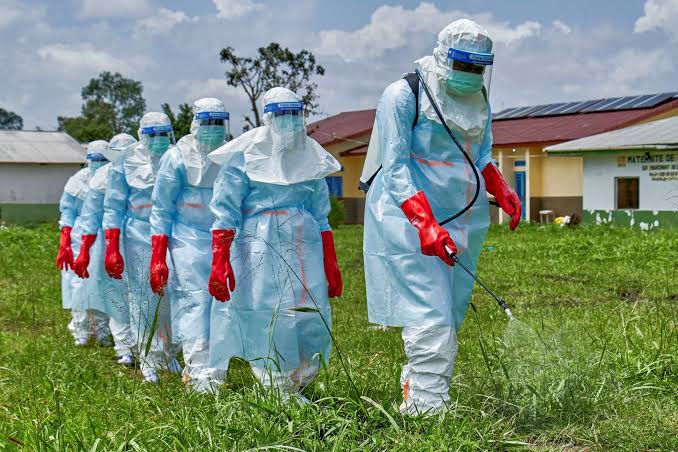
The outbreak is unfolding amid insecurity, population displacement, poor infrastructure and resistance to health interventions, making it difficult for response teams to reach some affected communities.
The WHO has previously reported attacks on health facilities and warned that insecurity was disrupting surveillance and response operations. Community mistrust and misinformation have also complicated efforts to persuade people to seek treatment and cooperate with health teams.
The crisis suffered another setback this week when soldiers reportedly burned an Ebola treatment centre in a displacement camp near Bunia while searching for weapons. The incident forced thousands of displaced residents to flee and further reduced available treatment capacity.
Despite the challenges, health authorities have expanded the use of mobile laboratories to speed up diagnosis. Testing that previously could take as long as 72 hours can now reportedly be completed in about six hours in some locations, allowing suspected cases to be identified more quickly.
Signs of slowing, but risks remain
Health authorities and international partners have reported signs that transmission has slowed in some parts of Ituri. However, the virus continues to spread in other parts of the country, including North Kivu, while South Ubangi recently became the seventh affected province.
The WHO continues to classify the outbreak as a Public Health Emergency of International Concern, reflecting the potential for further spread within the region.
With thousands of deaths already recorded and health workers demanding payment for their work, authorities face the dual challenge of maintaining the response workforce while overcoming insecurity, community mistrust and logistical difficulties in affected areas.