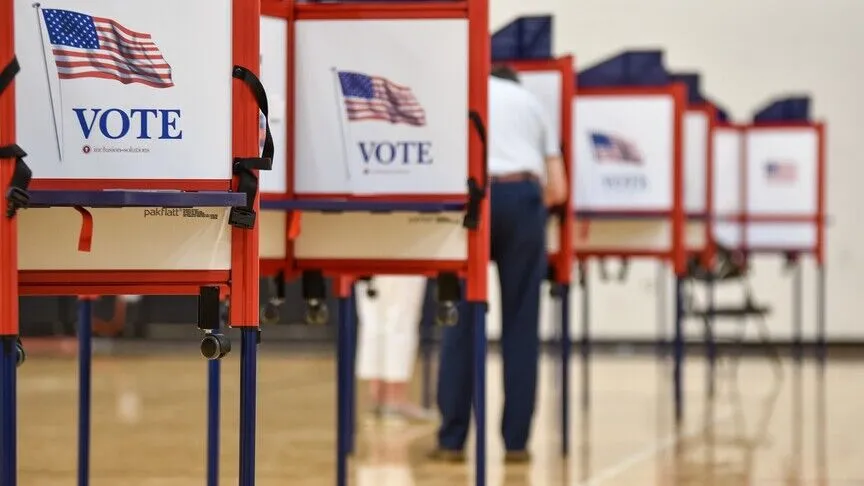
Democratic candidates are making unexpected gains in several traditionally Republican states as the November 2026 US midterm elections enter their final weeks, putting the Republican Party’s Senate majority under increasing pressure.
Recent polls show Democrats either leading or running competitively in a number of states that President Donald Trump carried comfortably in the 2024 presidential election. The shift has expanded the Democrats’ potential route to reclaiming control of the Senate.
Republicans currently hold 53 of the Senate’s 100 seats, while Democrats and two independents aligned with them hold 47. Democrats need a net gain of four Republican-held seats to secure a majority, provided they retain their existing seats.
Red states become competitive
The most striking development has been the emergence of traditionally Republican states as serious Democratic targets.
Reuters reported that Democrats are now competitive in 10 states that Trump won by double-digit margins in 2024: Ohio, Alaska, Iowa, Texas, Kansas, Nebraska, Mississippi, South Carolina, Florida and Kentucky.
Several of those contests have moved particularly close.
In Texas, Democratic state Rep. James Talarico was leading Republican Attorney General Ken Paxton 51 per cent to 49 per cent in a Fox News poll updated on October 2. Texas has been a Republican stronghold in presidential elections for decades, making the contest one of the most closely watched races of the cycle.
In Iowa, Democrat Josh Turek led Republican Rep. Ashley Hinson 49 per cent to 47 per cent in the same Fox News polling, while Democrat Abdul El-Sayed held a narrow 50-49 per cent advantage over Republican Mike Rogers in Michigan.
Ohio has also become highly competitive. A USA Today/Suffolk University poll released September 30 put Democratic former senator Sherrod Brown ahead of Republican Sen. Jon Husted, 47 per cent to 43 per cent.
Kansas becomes an unexpected battleground
Perhaps the biggest surprise is Kansas.
Trump won the state by 16 percentage points in 2024, but recent polling has shown Democrat Adam Hamilton within striking distance of Republican Sen. Roger Marshall.
An Emerson College poll cited by Reuters showed Hamilton leading Marshall 45 per cent to 43 per cent, with eight per cent undecided.
The development illustrates how dramatically the political environment has shifted in parts of the country that Republicans previously considered relatively safe.
Georgia and North Carolina shift the Republican strategy
The Democratic gains are not limited to states Trump won by large margins.
In Georgia, Democratic Sen. Jon Ossoff is now considered to have a strong position in his re-election campaign against Republican challenger Mike Collins. In North Carolina, former Democratic governor Roy Cooper is also mounting a serious challenge in a state Trump won narrowly in 2024.
The competitiveness of the two races has reportedly forced Republican strategists to reconsider how they allocate campaign resources.
The Associated Press reported that Republican officials are increasingly looking toward states such as Texas and Ohio, where they believe their candidates may have stronger prospects, while facing difficulties in Georgia and North Carolina.
Why Democrats are gaining
Several factors appear to be contributing to the shift.
President Trump’s approval ratings and voter concerns about the economy, inflation and the cost of living have created difficulties for Republican candidates seeking to defend the party’s Senate majority.
Recent polling also suggests that voters are increasingly blaming Republicans for economic problems while giving Democrats an advantage on issues such as the cost of living.
An AP-NORC poll conducted from September 24 to 28 found that 38 per cent of registered voters preferred Democrats to handle cost-of-living issues, compared with 27 per cent who preferred Republicans. At the same time, the survey found widespread dissatisfaction with both parties.
The political environment has therefore created an unusual situation in which Democrats are making gains even in states that remain fundamentally Republican-leaning.
Polls do not guarantee victory
Despite the favourable polling for Democrats, the races remain uncertain.
Polls measure voter sentiment at a particular point in time and do not guarantee election results. Reuters noted that polling has occasionally failed to capture late changes in voter behaviour, while Republicans retain substantial financial resources for the final weeks of campaigning.
Republican Senate campaign chairman Tim Scott has also maintained that his party has the resources to compete. Associated Press reported that Republican-aligned groups have already committed hundreds of millions of dollars to Senate contests and that additional spending is expected before Election Day.
A potential Senate power shift
The stakes are particularly high because Democrats do not need to win every competitive race to take control of the chamber.
Their clearest route requires holding their existing seats while capturing four Republican-held seats. But because at least two of those victories would have to come in states Trump won by double digits, the competitiveness of places such as Texas, Iowa and Kansas has dramatically improved the Democrats’ prospects.
The Cook Political Report currently describes the Senate contest as effectively a toss-up, while other election analysts have given Democrats an increasingly favourable outlook.
With Election Day scheduled for November 3, both parties are entering the final stage of an unusually competitive Senate campaign.
For Republicans, the challenge is to prevent a broader backlash against the Trump administration from turning traditionally safe seats into Democratic victories. For Democrats, the opportunity is to convert narrow polling leads and voter dissatisfaction into enough victories to reclaim control of the Senate.
The emerging picture suggests that the 2026 midterms could be decided not only in traditional swing states, but also in parts of the Republican heartland once considered largely out of reach for Democrats.