As Nigeria enters the final stretch of President Bola Ahmed Tinubu’s first term, with the 2027 election less than sixteen months away, the country’s fractured opposition appears to be making its final moves. Behind closed doors and in carefully worded public statements, political actors who found themselves on the losing side of the 2023 election are engaging in what looks like a last-ditch effort at unity—one that could reshape the landscape ahead of next year’s crucial vote.
The signs are subtle but unmistakable. Former Vice President Atiku Abubakar and former Labour Party candidate Peter Obi, who together commanded millions of votes in 2023, have been spotted at the same events with increasing frequency. Their aides no longer issue the sharp rebukes that characterized their relationship during the last campaign. Meanwhile, smaller parties that barely registered in 2023 are holding what they describe as “consultative meetings” about the future of Nigerian democracy.
But the most dramatic development has emerged in recent weeks: both Atiku and Obi have reportedly left their respective parties—the People’s Democratic Party and Labour Party—to join the African Democratic Congress (ADC). If confirmed, this represents a seismic shift in Nigeria’s opposition politics and potentially the foundation of the unified front that eluded them in 2023.
The ADC, previously considered a minor player in Nigerian politics, suddenly finds itself at the center of what could become the most significant opposition realignment in years. The party’s relatively clean slate—unburdened by the baggage of the PDP’s checkered history or the Labour Party’s internal squabbles—appears to have provided neutral ground for two political heavyweights who could never have merged their original platforms without one appearing subordinate to the other.
“What we’re witnessing is unprecedented, and the timing is critical,” explains Dr. Chidi Odinkalu, a political analyst based in Abuja. “Atiku leaving the PDP, a party he helped build and has returned to multiple times, signals that this is more than political theater. With less than eighteen months to the election, these are politicians making desperate but calculated gambles for what they see as their last realistic chance at the presidency.”
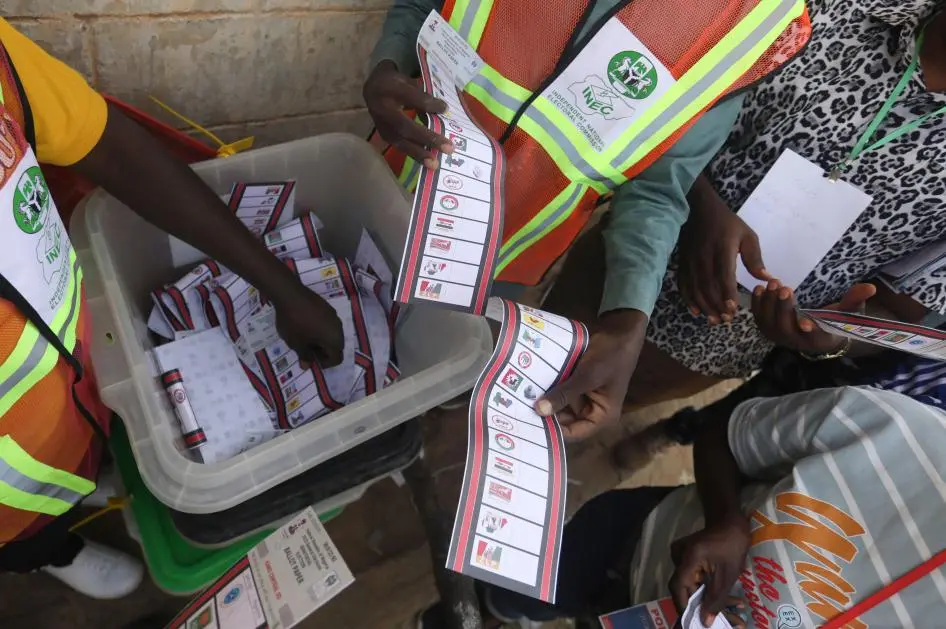
The numbers from 2023 tell a compelling story that makes this convergence logical, if not inevitable. President Tinubu won with approximately 8.8 million votes in a fragmented field. Atiku garnered roughly 7 million votes, while Obi’s surprisingly strong showing brought in about 6.1 million. Together, the main opposition candidates received significantly more votes than the winner—a fact not lost on their strategists as they face the reality that 2027 may be their final opportunity.
The ADC move suggests some hard lessons have been learned, though the late timing raises questions about whether there’s sufficient time to build a winning coalition. Rather than attempting an awkward merger between the PDP and Labour Party—each with its own structures, loyalties, and internal politics—starting fresh under the ADC banner allows both leaders to bring their supporters into a new house where neither has historical claim to dominance.
However, the defections have not been without controversy. Within the PDP, Atiku’s departure has triggered a mixture of shock and recrimination. Party loyalists who stood by him through multiple presidential runs feel abandoned at a crucial moment. Similarly, Labour Party supporters, particularly young voters who saw their movement as a break from traditional politics, are questioning whether Obi’s move represents pragmatism or betrayal of the grassroots energy that propelled him in 2023.
The Wike Factor: Political Earthquake in Rivers
Yet even as the opposition attempts this eleventh-hour consolidation, a parallel drama in Rivers State threatens to complicate the entire landscape. Former Rivers State Governor Nyesom Wike, once considered the PDP’s strongman in the South-South, currently serves as Minister of the Federal Capital Territory in President Tinubu’s APC-led government—while maintaining his membership in the PDP.
This political straddling has created what observers call the most bizarre arrangement in contemporary Nigerian politics: a PDP member serving in an APC cabinet, wielding federal power while ostensibly remaining in opposition.
The situation has deteriorated further with the ongoing battle between Wike and his successor, Governor Siminalayi Fubara. What began as a political disagreement has escalated into a full-blown crisis that has paralyzed governance in one of Nigeria’s wealthiest states. In a move that sent shockwaves through the political establishment, Fubara has now decamped from the PDP to the APC, effectively completing his break from his former political godfather.
“Wike’s position is untenable and everyone knows it,” says Amina Salihu, a political consultant in Kano. “He’s a PDP member collecting APC salary, fighting a governor who has now joined the APC. It’s political schizophrenia on a grand scale, and it perfectly illustrates why the PDP is hemorrhaging relevance at the worst possible time—just months before an election.”
The Rivers crisis has exposed the rot at the heart of the PDP. The party has proven unable to discipline Wike for serving in an opposition government, unable to protect Fubara from political harassment, and unable to prevent the state from slipping entirely into APC hands. For a party already reeling from Atiku’s departure with an election looming next year, the Rivers debacle represents an existential crisis.
Moreover, Wike’s continued presence in Tinubu’s government provides the APC with invaluable intelligence on PDP operations and a powerful spoiler within opposition ranks. His control over federal resources through the FCT Ministry gives him leverage that extends far beyond Rivers State, allowing him to reward loyalty and punish dissent across the South-South region—crucial territory in next year’s election.
“Wike is Tinubu’s insurance policy against opposition unity,” argues Dr. Odinkalu. “As long as he remains in the cabinet while technically a PDP member, he can sabotage any serious challenge from within. It’s brilliant politics, even if it’s terrible for democracy. And with the election next year, his intelligence value to the APC is at its peak.”
The timing of Fubara’s defection to the APC is particularly damaging to opposition morale as the campaign season approaches. It signals that even politicians who emerged from PDP ranks see better prospects with the ruling party. The symbolism is devastating: Rivers State, once a PDP fortress that delivered millions of votes, is now firmly in APC hands, with its sitting governor having abandoned ship just as the 2027 battle begins.
Youth Disillusionment and Economic Realities
Youth voters, who energized Obi’s campaign in 2023, represent both an opportunity and a critical test for the nascent ADC alliance. Many remain disillusioned with traditional political structures and deeply skeptical of what appears to be another elite arrangement. The challenge for the ADC will be maintaining the outsider energy that defined Obi’s campaign while incorporating Atiku’s political experience and Northern appeal—all with barely a year to convince skeptical young voters.
The Wike-Fubara saga only deepens this cynicism. Young voters watching a PDP minister serve an APC president while fighting a governor who fled to the APC are asking hard questions about whether any political realignment represents genuine change or merely musical chairs among the elite as the election approaches.
The ruling All Progressives Congress is watching these developments with a mixture of satisfaction and strategic calculation. Party insiders are publicly dismissive of the ADC move, characterizing it as too little, too late. Yet privately, they acknowledge that a unified opposition ticket combining Atiku’s Northern base with Obi’s Southeast and urban youth support represents a potential threat, even with limited time to organize.
“They know their history,” notes a senior APC strategist who spoke on condition of anonymity. “The APC itself was born from merging opposition parties in 2013. But they also know we have Wike inside their tent, we just gained an entire state, and most importantly, we have less than eighteen months of incumbency advantage to leverage. The opposition is consolidating, but so are we—and we have the federal machinery.”
The Mathematics of 2027
The question of who would lead the ADC ticket in next year’s election remains carefully unaddressed in public, though speculation is rampant and time is running out for indecision. Age considerations favor Obi, who is younger, but regional politics and the unwritten rule of rotating power between North and South complicate the calculation. Some observers believe the two leaders have already negotiated a formula—perhaps an Atiku presidency with Obi as vice president, or vice versa—with the understanding that whoever doesn’t run in 2027 may be too old for 2031.
Regional dynamics add another layer of complexity with the clock ticking. The Southwest, Tinubu’s base, remains largely loyal to the APC. The Southeast, where Obi dominated, wants a shot at the presidency after decades of exclusion. The North, traditionally Atiku’s stronghold, holds the numerical advantage that no candidate can ignore. The South-South, once a PDP stronghold, is now contested territory with Wike’s machinations and Fubara’s defection threatening to deliver the entire region to the APC.
The ADC’s success will depend on whether it can weave these regional threads into a coherent national tapestry while competing against an APC that has proven adept at using federal power, strategic defections, and figures like Wike to fragment opposition unity—all within the compressed timeline of an election year.
Economic conditions may prove decisive. With inflation remaining stubbornly high and the removal of fuel subsidies continuing to squeeze ordinary Nigerians, the political environment in 2027 will likely be defined by economic frustration. Opposition figures are betting that widespread dissatisfaction could override the ethnic and regional calculations that typically fragment the anti-government vote. However, converting economic anger into electoral victory requires organization and time—both of which are in short supply.
Building From Scratch—Against the Clock
The immediate and most daunting challenge facing the ADC is organizational. Unlike the PDP’s nationwide structures or even Labour Party’s grassroots networks, the ADC must build from relative obscurity to presidential competitiveness in less than eighteen months. This will require not just money and messaging, but the successful integration of two distinct political cultures and support bases—a process that typically takes years, not months.
Voter registration, party agent recruitment, polling unit presence, and state-level structures all need to be established or dramatically expanded before the election. The ADC is essentially attempting to build a presidential campaign infrastructure in the time most parties spend fine-tuning existing machinery.
Meanwhile, the PDP faces an identity crisis at the worst possible moment. Stripped of Atiku, humiliated in Rivers State, and unable to discipline a minister serving in an opposition government, the party that ruled Nigeria for sixteen years appears to be in terminal decline just as campaign season begins. Some analysts believe the PDP may not survive to 2027 as a serious political force, with its remaining governors and federal legislators facing intense pressure to decamp to either the APC or the emerging ADC before it’s too late to matter.
“The ADC now has star power, but can it translate that into ground game in less than eighteen months?” asks Dr. Odinkalu. “Elections in Nigeria are won in the wards and polling units, not in Abuja press conferences. The APC has federal might, incumbency advantage, and a man like Wike who knows how to win ugly. The opposition has momentum but possibly not enough time.”
The Final Countdown
As Nigeria hurtles toward the 2027 election, the convergence of Atiku and Obi under the ADC banner represents the boldest—and perhaps last—gambit by the country’s opposition. Whether this alliance can overcome the Wike spoiler effect, rebuild collapsed structures, establish a functioning campaign in record time, and present a credible alternative to APC dominance—or collapse under the weight of clashing ambitions, strategic sabotage, insufficient time, and disappointed supporters—will be determined not in years but in months.
The political calendar is unforgiving. Party primaries, campaign rallies, voter mobilization, and the election itself will arrive with stunning speed. Every day spent on internal negotiations is a day not spent building the machinery needed to win.
For now, the dance has ended. The real battle has just begun. And in Rivers State, the casualties are already mounting. With next year’s election approaching rapidly, Nigeria’s opposition has run out of time for false starts. This is their final chance—and they know it.