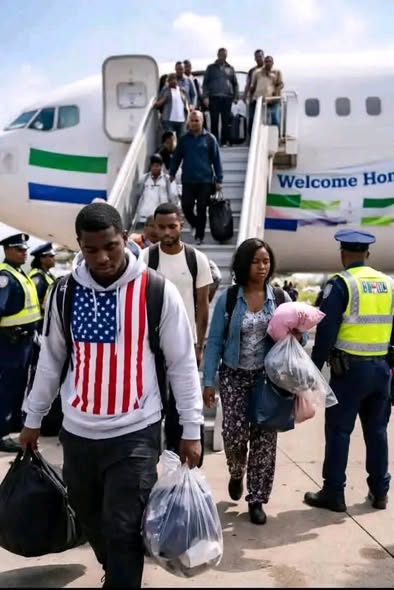
A chartered flight carrying the first group of West African migrants deported from the United States landed at Freetown International Airport on Wednesday, officially activating a controversial third-country migration agreement between the United States and Sierra Leone.
The aircraft arrived with nine deportees — seven men and two women — from Nigeria, Ghana, Guinea, and Senegal. Although U.S. authorities had initially planned to remove 25 individuals on the flight, several deportations were halted at the last minute following emergency legal interventions by immigration lawyers in the United States.
The agreement allows Sierra Leone to receive up to 300 deported migrants annually from the United States, with a monthly cap of 25 individuals. Under the arrangement, Freetown will only accept nationals from member states of the Economic Community of West African States (ECOWAS).
In support of the initiative, Washington has provided Sierra Leone with a $1.5 million operational grant intended to manage logistics and humanitarian support for the deportees.
Officials say the deportees will be temporarily housed in secure accommodation near the airport for between 14 and 30 days before arrangements are made for their return to their respective home countries.
Sierra Leone’s Foreign Affairs Minister, Timothy Musa Kabba, defended the agreement, describing it as both a humanitarian obligation and part of broader diplomatic cooperation with Washington.
“We are taking in these deported people because they are from West Africa, and some of them hold Sierra Leonean residence permits obtained many years ago,” Kabba said.
Security at the airport was tight as armed police officers, medical personnel, and social workers received the deportees upon arrival. Witnesses reported tense scenes on the tarmac, with one individual initially refusing to leave the aircraft before being persuaded by officials.
Doris Bah, a health official attached to Sierra Leone’s Ministry of Health, said many of the deportees appeared traumatized after extended detention periods in the United States.
According to Bah, several individuals claimed they had been detained during routine activities, including while at work or playing football, and alleged they were held in restraints during parts of their detention.
The migrants were later transferred under police escort to two hotels managed by private contractor Kenvah Solutions, which has been tasked with overseeing their temporary welfare and accommodation.
The agreement places Sierra Leone among a growing number of African nations — including Ghana, Rwanda, Cameroon, Equatorial Guinea, and Eswatini — that have entered into third-country deportation arrangements with the United States as Washington intensifies immigration enforcement measures.
However, the policy has sparked criticism from human rights organizations and immigration advocates, who argue that the deals undermine international refugee protections and risk exposing deportees to further hardship.
Critics have expressed concern that migrants previously granted legal protections in the United States, including relief under the United Nations Convention Against Torture, could ultimately be returned to their countries of origin despite court protections.
The latest agreement also marks a major shift in relations between Washington and Freetown. In 2017, during the administration of former U.S. President Donald Trump, the United States imposed visa sanctions on Sierra Leonean officials over disagreements concerning deportation cooperation.
By agreeing to receive deportees from across West Africa, Sierra Leone has eased long-standing diplomatic tensions with Washington, though the move is already generating political debate and scrutiny both domestically and across the region.