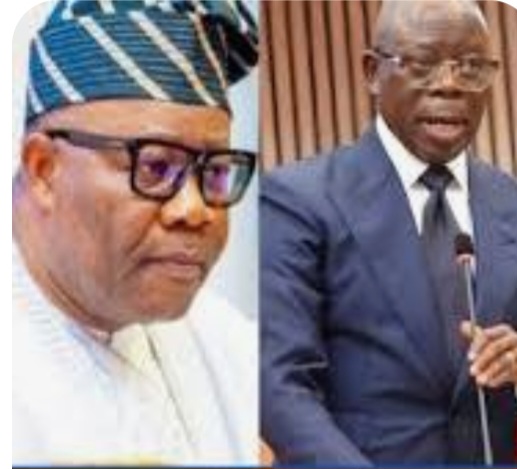
Senator Adams Oshiomhole has claimed that Senate President Godswill Akpabio views him with suspicion and regards him as a political adversary, describing the Senate leader as being “paranoid” about his intentions within the National Assembly.
Oshiomhole, who represents Edo North Senatorial District in the Senate, made the remarks while addressing political developments within the upper legislative chamber. The former governor of Edo State and ex-national chairman of the ruling All Progressives Congress (APC) suggested that tensions between himself and Akpabio have contributed to a strained working relationship in the Senate.
According to Oshiomhole, the Senate President perceives him as a threat and treats him as though he were an opponent rather than a colleague. He alleged that Akpabio’s attitude toward him stems from fears about political maneuvering within the Senate, despite his insistence that he remains focused on legislative responsibilities and national issues.
“Akpabio sees me as a devil,” Oshiomhole was quoted as saying, arguing that the Senate President has become overly concerned about his influence and activities within the chamber.
The senator also predicted that the current leadership arrangement in the 11th Senate may not remain unchanged throughout its tenure. While he did not provide specific details about any planned challenge to Akpabio’s position, Oshiomhole expressed confidence that political realities could eventually lead to a change in leadership.
His comments have fueled speculation about possible divisions within the Senate and the ruling APC, particularly as lawmakers continue to navigate internal power dynamics and legislative priorities.
Political observers note that leadership contests and alignments have historically played a significant role in Nigeria’s National Assembly, with shifts in alliances often influencing the direction of parliamentary proceedings.
The remarks come amid increasing public discussions about the state of relations among key figures in the Senate. Although both Oshiomhole and Akpabio belong to the APC, reports of disagreements between influential lawmakers have occasionally surfaced since the inauguration of the 10th National Assembly in 2023.
Analysts say that while disagreements are common in democratic institutions, public expressions of mistrust between senior legislators could affect cohesion within the Senate if not carefully managed.
Neither Akpabio nor his office had immediately issued a formal response to Oshiomhole’s comments at the time of filing this report.
Despite the apparent friction, political stakeholders have continued to urge lawmakers to prioritize governance, legislative oversight, and reforms aimed at addressing the country’s economic and security challenges.
As debates over leadership and influence within the Senate continue, attention is likely to remain focused on whether the disagreements will evolve into a broader political contest or remain part of the routine dynamics of parliamentary politics.
The development adds another layer to ongoing conversations about power, loyalty, and leadership within Nigeria’s legislature, with observers watching closely for any signs of further realignments in the months ahead.