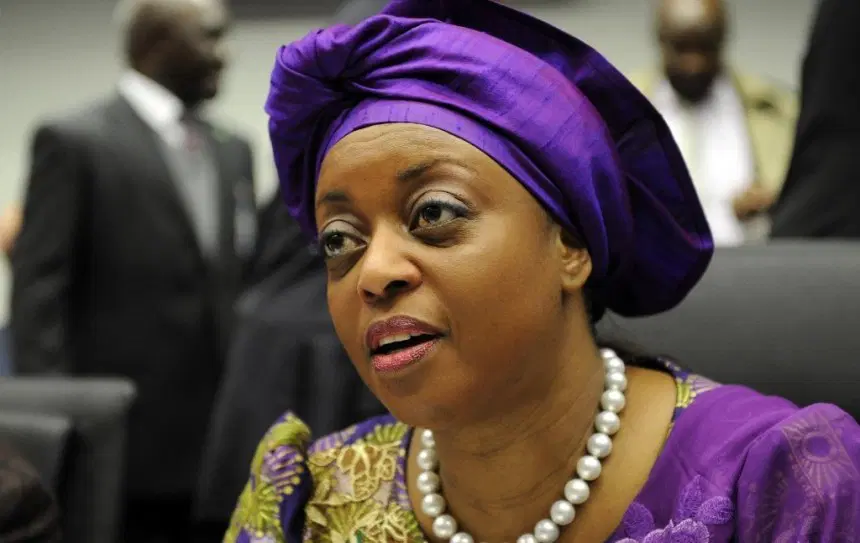
More than a decade after corruption allegations transformed her from one of Africa’s most influential oil ministers into one of Nigeria’s most controversial public figures, former Minister of Petroleum Resources Diezani Alison-Madueke has won a significant legal victory in the United Kingdom.
A jury at Southwark Crown Court in London acquitted Alison-Madueke of all six counts of bribery and conspiracy brought against her by the UK’s National Crime Agency (NCA), bringing an end to one of the most closely watched international corruption trials involving a former Nigerian government official.
For Alison-Madueke, the verdict represents the end of an eleven-year legal battle in Britain. But while the acquittal clears her of criminal wrongdoing in the UK, it has also reignited a broader question: Can a single court judgment erase years of public distrust, corruption allegations and ongoing legal proceedings in Nigeria?
Alison-Madueke served as Nigeria’s Minister of Petroleum Resources between 2010 and 2015 under former President Goodluck Jonathan. During that period, she also made history as the first woman to serve as President of the Organization of the Petroleum Exporting Countries (OPEC).
Following the end of the Jonathan administration in 2015, she became the subject of multiple corruption investigations in Nigeria, the United Kingdom and the United States.
British authorities arrested her in London in October 2015 as part of a long-running investigation into allegations that she accepted expensive gifts and financial benefits from businessmen seeking influence over Nigeria’s lucrative oil industry.
After years of investigations, prosecutors formally charged her in 2023 with receiving luxury properties, chauffeur services, private jet travel, designer shopping trips and cash payments in exchange for favourable treatment in the award of oil contracts.
However, after hearing the evidence, the jury unanimously acquitted Alison-Madueke, ruling that prosecutors had failed to establish the allegations beyond reasonable doubt.
Reacting to the verdict, Alison-Madueke described the acquittal as the end of a long personal nightmare, insisting she had always maintained her innocence.
For her supporters, the judgment is proof that allegations alone should never replace evidence and that due process ultimately prevailed.
But for many Nigerians, the acquittal is unlikely to erase years of damaging headlines that made Alison-Madueke one of the country’s most recognisable symbols of alleged high-level corruption.
Throughout the past decade, her name has repeatedly surfaced in reports of missing public funds, asset seizures and international investigations, shaping public perception long before any criminal court delivered a verdict.
Although the UK criminal case has ended, Alison-Madueke’s legal challenges in Nigeria are far from over.
The Economic and Financial Crimes Commission (EFCC) has secured several interim and final forfeiture orders involving billions of naira in cash, luxury homes, commercial buildings and other assets allegedly linked to proceeds of corruption.
Among the recovered assets are high-value properties in Lagos and Abuja, including luxury apartments and commercial real estate, as well as large sums recovered from bank accounts.
Authorities in the United States have also recovered assets allegedly connected to Alison-Madueke and her associates, including the luxury superyacht Galactica Star and high-end real estate.
The former minister has consistently denied ownership of many of the seized assets, arguing that investigators failed to establish a direct connection between her and the properties.
Following her acquittal, she is expected to challenge several of the forfeiture orders before Nigerian courts.
Legal experts say the London acquittal does not automatically reverse asset forfeitures already granted in Nigeria.
Unlike criminal prosecutions, which require proof beyond reasonable doubt, civil forfeiture proceedings operate under a lower legal standard known as the balance of probabilities.
As a result, an individual may be acquitted in a criminal court while courts in another jurisdiction still uphold the forfeiture of assets through separate civil proceedings.
The verdict therefore strengthens Alison-Madueke’s public claim of innocence but does not automatically restore any of the assets previously confiscated.
Perhaps Alison-Madueke’s greatest challenge now lies outside the courtroom.
For many Nigerians, the controversy surrounding her tenure extends beyond criminal convictions or acquittals. Years of corruption allegations, investigations, parliamentary probes and reports on Nigeria’s troubled oil sector have left a lasting imprint on public consciousness.
Anti-corruption organisations have argued that while the UK prosecution failed to meet the criminal burden of proof, the acquittal should not be interpreted as a declaration that no wrongdoing ever occurred.
Others contend that the judgment reinforces the principle that every accused person deserves a fair trial and that allegations must be proven with credible evidence before criminal liability can be established.
The London verdict undoubtedly marks one of the biggest legal victories of Alison-Madueke’s career.
Yet, despite clearing her of criminal charges in the United Kingdom, it may not immediately repair a reputation shaped by more than a decade of investigations, asset recoveries and public scrutiny.
As she prepares fresh legal battles to reclaim seized assets in Nigeria, the former petroleum minister finds herself confronting a different challenge—one that no court can easily resolve.
While the criminal case has ended, the debate over her legacy, her stewardship of Nigeria’s petroleum sector and the public perception of her role during one of the country’s most controversial political eras is likely to continue for years to come.