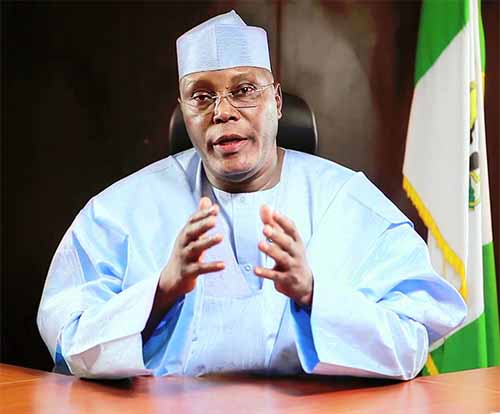
Former Vice President Atiku Abubakar has criticised the Federal Government’s claims that Nigeria’s economy is on the path to recovery, arguing that the realities faced by ordinary Nigerians tell a different story.
In a statement released on Sunday, Atiku said worsening living conditions, rising unemployment and the decline of the country’s manufacturing sector undermine the government’s narrative of economic progress. He maintained that while official statistics may point to improvements in some macroeconomic indicators, millions of Nigerians continue to grapple with high living costs and shrinking purchasing power.
The former presidential candidate questioned the basis for the government’s optimism, noting that many businesses have either scaled down operations or shut their doors due to rising production costs, unstable electricity supply, foreign exchange challenges and inflation.
According to Atiku, Nigeria’s manufacturing sector widely regarded as a key driver of industrial growth and job creation has suffered significant setbacks, with many firms struggling to remain competitive amid the country’s difficult economic environment.
He argued that economic recovery should be measured not only by macroeconomic indicators but also by improvements in citizens’ welfare, employment opportunities and the performance of productive sectors.
“The true measure of economic recovery is whether citizens can afford basic necessities, businesses are expanding, and industries are creating jobs,” Atiku said, urging the government to adopt policies that stimulate production, support local industries and ease the burden on households.
The Federal Government has consistently defended its economic reforms, including the removal of petrol subsidies and the liberalisation of the foreign exchange market, arguing that they are necessary to stabilise the economy and lay the foundation for long-term growth. Officials have pointed to recent improvements in external reserves, increased investor confidence and a moderation in inflation as signs that the reforms are beginning to yield results.
However, critics contend that despite these indicators, many Nigerians continue to experience rising food prices, transportation costs and other living expenses, while manufacturers face persistent operational challenges.
Atiku urged the government to prioritise policies that directly improve the livelihoods of Nigerians, revive the manufacturing sector and create sustainable employment, stressing that genuine economic recovery must be reflected in the everyday experiences of citizens rather than in official data alone.