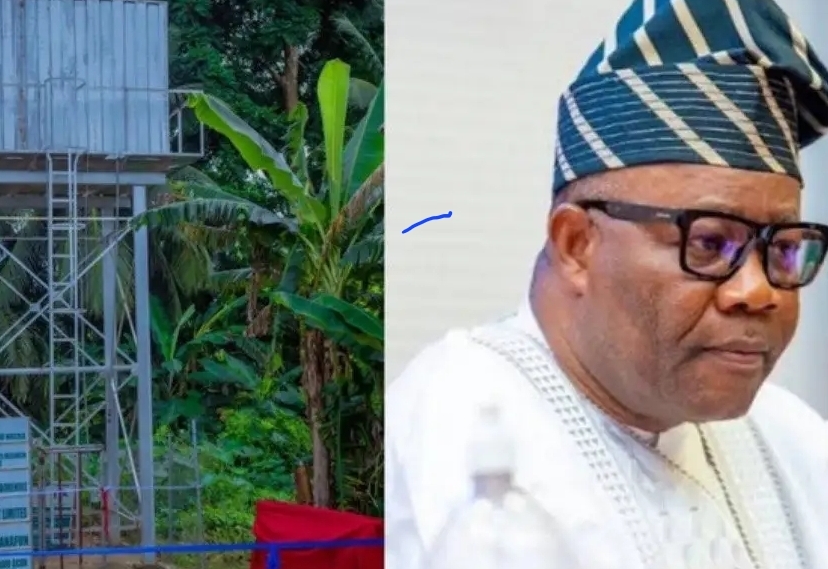
Nigerians on social media have criticised Senate President Godswill Akpabio over the reported commissioning of a solar-powered borehole project at Akwa Ibom State Polytechnic, questioning the scale and significance of the project.
The reactions followed the circulation of reports and images of the project, with some Nigerians expressing disbelief that a relatively basic water infrastructure project had attracted such public attention at a time when they expect government officials to focus on larger development challenges.
The project reportedly provides water through a borehole powered by solar energy, an approach increasingly adopted in communities and public institutions where reliable electricity remains a challenge.
However, rather than focusing on the technology behind the project, some social media users questioned whether such an initiative should be presented as a major achievement by a high-ranking public official.
The criticism was particularly focused on the perceived modest nature of the project.
Some Nigerians asked why a solar-powered borehole should generate significant publicity when access to potable water is widely regarded as a basic public need.
The phrase “Are we still fools in 2026?” became part of the online reaction, reflecting the frustration of users who believed that public officials should be held to higher standards when announcing development projects.
Others argued that the provision of water infrastructure should be accompanied by broader investments in education, healthcare, roads, electricity and employment opportunities.
The criticism also reflects a wider debate in Nigeria over constituency and intervention projects, particularly those sponsored by lawmakers using public funds.
Solar-powered boreholes use solar panels to generate electricity for pumping underground water into storage tanks and distribution systems.
The technology can be useful in locations where access to a stable electricity supply is limited because it reduces dependence on the national grid and diesel-powered generators.
For educational institutions such as polytechnics, reliable access to water is important for students, staff, sanitation and other daily activities.
Despite this, critics maintained that the availability of such infrastructure should not necessarily be presented as an extraordinary accomplishment, particularly when many public institutions still struggle with inadequate facilities.
The controversy has also reignited discussions about how government projects are selected, funded and publicised.
Supporters of constituency projects often argue that small-scale interventions can have a direct impact on communities and should not be dismissed simply because they are modest.
Critics, however, contend that public officials should prioritise projects based on broader development needs and ensure transparency over the cost, funding source and expected impact of each intervention.
They also argue that projects funded with public resources should be subjected to proper scrutiny, regardless of the political figure associated with them.
Akpabio, a former governor of Akwa Ibom State, currently serves as President of the Nigerian Senate and represents Akwa Ibom North-West Senatorial District.
His political prominence has made projects associated with him a subject of public interest, particularly in his home state.
The latest controversy highlights the increasingly intense scrutiny faced by Nigerian political leaders over development projects, with social media providing a platform for citizens to publicly question government spending and priorities.
While the solar-powered borehole may provide a practical benefit to students and staff at the polytechnic, the reaction demonstrates that Nigerians are increasingly demanding more information about the cost, scope and long-term impact of publicly funded projects.
The debate is therefore not only about the borehole itself but also about what citizens should reasonably expect from government and elected officials in terms of development and accountability in 2026.