Senator Seriake Dickson, National Leader of the National Democratic Congress (NDC), brought together founding members and former leaders of the defunct Alliance for Democracy (AD) at an emotional reunion in Abuja on Saturday, using the occasion to warn against the growing militarisation and monetisation of Nigeria’s electoral process.
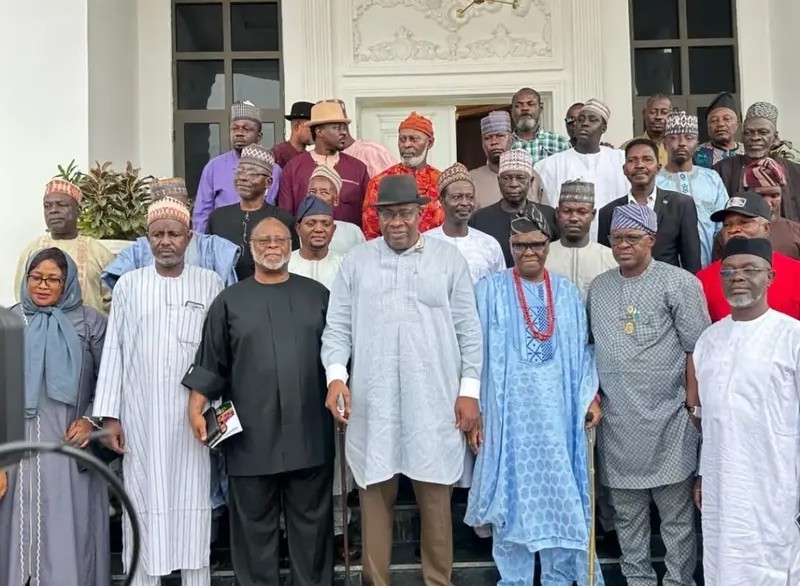
Dickson hosted the founding members, leaders and associates of the Alliance for Democracy at his private residence in Abuja, disclosing the gathering in a post on his X handle. The event was tagged “The Epochal Homecoming Reunion of the Old Guard Alliance for Democracy,” convened under the auspices of the NDC with the theme “Reclaiming Our Moral Mandate: A National Democratic Conversation for a Reborn Polity.”
Among those who attended were one of the AD’s founding fathers, Chief Michael Odurinde; the party’s founding National Secretary, Prof. Udenta Udenta; and Dr Manzo Abubakar, former Protem National Publicity Secretary and leader of the AD’s Northern Caucus, along with other former officials.
Dickson said he was particularly pleased to host colleagues with whom he had worked for about 27 years, describing the reunion as a long-overdue opportunity to rekindle old friendships and strengthen networks. He said the gathering also gave his family the chance to host a meeting that, in his view, should have taken place much earlier.
Recalling the early years of Nigeria’s current democratic era, Dickson noted that the country had only three registered political parties when the Fourth Republic began in 1998/1999. He said his own political journey started during that period as the founding State Chairman of the AD, before he later rose to become the party’s National Legal Adviser.
“The AD was an ideological and principled party,” Dickson said, describing his time in the AD and his involvement in the Ijaw and Niger Delta movements as formative experiences that shaped his approach to political organisation and principled opposition. He added that engaging in principled politics requires conviction, courage and commitment, qualities he said had continued to guide his career.
He said that despite having moved in different political directions over the years, the former colleagues had remained committed, in different forms and circumstances, to the advancement of democracy in Nigeria, and that the group would continue to “rub minds together” and advise itself on issues affecting the country.
Beyond the nostalgia, Dickson used the platform to raise pointed concerns about the conduct of Nigeria’s ongoing elections. Speaking on the same day Osun State held its governorship election, the former Bayelsa State governor warned of the alleged militarisation and monetisation of Nigeria’s electoral process, describing it as a threat to democracy.
He said his concerns were not limited to the Osun poll but extended to other states where off-cycle elections and the forthcoming 2027 general elections would be conducted, stating: “As a person and as leader of the NDC, we are very concerned about the militarisation of states, not just Osun.” Dickson drew on his own experience, recalling the role played by federal security forces during his tenure as an opposition governor in Bayelsa State.
Speaking further after the meeting, Dickson said the gathering was primarily convened to reconnect former colleagues who worked together in the early years of the Fourth Republic, rather than to take definitive political positions on contemporary issues though he nonetheless used the occasion to voice concern over the monetisation of Nigeria’s electoral process.
Speaking further at the gathering, Dickson said Nigeria’s political culture was “dying” and that it was time to reclaim lost ideals, using the reunion as an opportunity for his political generation to reflect on their roles in Nigeria’s return to democratic rule and the principles that shaped their activism.
Organisers said the event was intended to open a wider conversation about the direction of Nigeria’s democracy and the kind of political leadership required to strengthen the country’s democratic institutions, describing it not as ceremonial nostalgia but as a deliberate effort to bring decades of political experience into today’s debates. A circular issued ahead of the event by Dr Manzo Abubakar had described the gathering as a chance for former political actors to bring their experience to bear on contemporary discussions about Nigeria’s political development, including the evolution of the country’s democratic system and the prospects for a more enduring political culture anchored on ideas and institutional responsibility.
In a statement issued ahead of the reunion, organisers described it as “neither nostalgia nor pageantry,” calling it instead “a deliberate act of political reclamation,” and saying the event would provide an opportunity for participants to “harmonise experience with vision, memory with mandate and legacy with responsibility.”