A newly signed U.S.-Iran interim agreement has triggered a fierce political and online backlash in the United States, as lawmakers, analysts, and social media users dispute the financial and strategic implications of the deal.
The controversy follows President Donald Trump’s reported signing of a 14-point Memorandum of Understanding with Iran at the G7 summit in France, aimed at ending a three-and-a-half-month conflict and establishing a 60-day framework for a permanent nuclear agreement.
While the White House has presented the accord as a stabilizing ceasefire mechanism paired with phased economic arrangements, the deal has quickly become a flashpoint in Washington, driven in part by viral graphics circulating online that compare it with the 2015 nuclear agreement under former President Barack Obama.
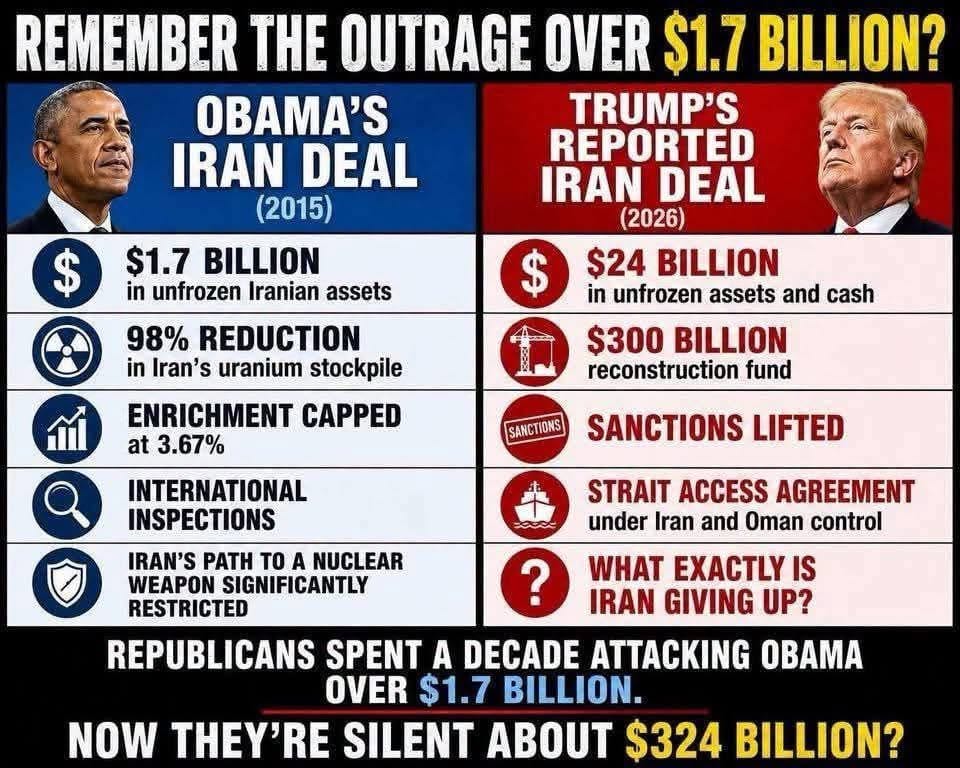
A widely shared image on social media platforms and messaging apps has drawn intense attention by placing side-by-side comparisons between the 2015 Joint Comprehensive Plan of Action (JCPOA) and the reported 2026 framework.
The graphic contrasts the Obama-era deal’s limited asset relief and strict uranium enrichment caps with claims that the new agreement involves significantly larger financial flows, including references to multi-billion-dollar asset releases and a proposed international reconstruction fund tied to Iran’s economic reintegration.
The viral comparison has been seized upon by critics of the administration, who argue it suggests disproportionate concessions to Tehran without clearly defined security guarantees.
The White House has rejected claims that the United States is directly funding Iran under the agreement.
President Trump, posting on Truth Social, dismissed the circulating figures as inaccurate, insisting that no direct U.S. taxpayer funds are being transferred to Iran. Administration officials say that any proposed financial mechanisms referenced in the agreement are dependent on private-sector participation and conditional on compliance with strict verification benchmarks.
Vice President JD Vance further clarified that any reconstruction financing would be contingent on Iran meeting long-term nuclear and security obligations, emphasizing that the framework does not authorize immediate cash transfers from the U.S. government.
Despite these clarifications, skepticism has emerged within both opposition ranks and segments of Trump’s own party. Some Republican lawmakers have questioned the optics of large-scale economic frameworks being associated with Iran while core security issues remain unresolved.
Senator Lindsey Graham was among those raising concerns, warning that even indirect financial normalization could weaken U.S. leverage if not tightly conditioned on verifiable nuclear dismantlement.
Analysts note that much of the dispute stems from differing interpretations of the agreement’s structure, particularly whether it constitutes immediate economic relief or a conditional framework dependent on future compliance.
Supporters of the administration argue the deal prioritizes strategic leverage by linking sanctions relief and economic reintegration to verifiable security outcomes, while critics say the sequencing risks front-loading concessions before enforceable guarantees are secured.
The interim agreement, signed amid broader regional tensions and fluctuating global oil prices, is expected to enter technical negotiations in the coming weeks. Diplomats on both sides are now tasked with converting the political framework into enforceable mechanisms covering nuclear restrictions, sanctions relief, and regional security arrangements.
As debate continues in Washington and online, analysts warn that the ultimate success or failure of the accord will depend on whether its disputed financial architecture can be translated into verifiable security commitments that withstand domestic political pressure and regional volatility.