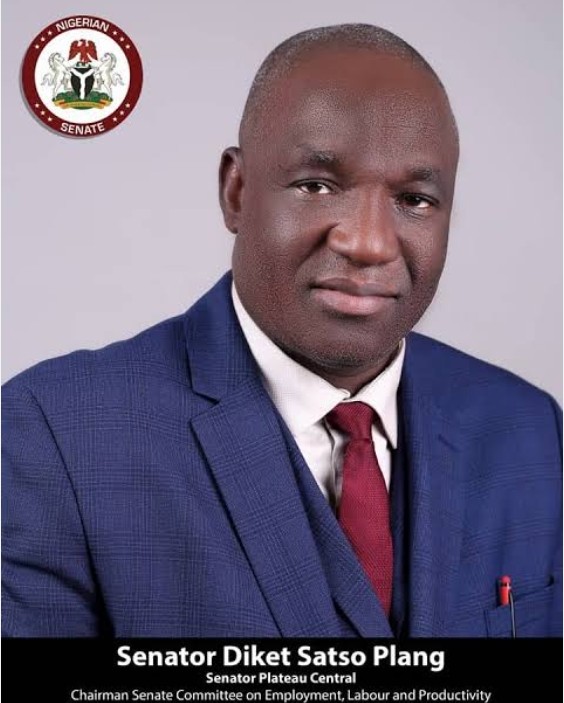
The Chairman of the Senate Committee on Labour, Employment and Productivity, Senator Diket Plang, has said the 10th Senate has processed more than 1,000 bills since its inauguration in June 2023, describing the legislative output as one of the chamber’s major achievements over the past three years.
Plang, who represents Plateau Central Senatorial District, said over 200 of the bills passed by the Senate have already received presidential assent from President Bola Tinubu, transforming them into laws.
Speaking in an interview to mark the third anniversary of the 10th Senate, the lawmaker said about 900 of the bills had progressed through either second or third reading, reflecting what he described as a high level of legislative activity.
According to him, beyond lawmaking, the Senate has also adopted numerous resolutions through motions and carried out extensive oversight of Ministries, Departments and Agencies (MDAs) to ensure accountability in governance.
“At the moment, the Senate has had over 1,000 bills. About 900 have passed either second or third reading, and we have over 200 bills that have been signed into law,” Plang said. “There is a lot of achievement in terms of making laws. We have had very important motions with beautiful resolutions and sufficient oversight functions as far as the first three years of the Senate are concerned.”
He explained that the Senate’s committee system has enabled lawmakers to closely monitor government performance, particularly during budget defence sessions and subsequent oversight visits to ministries, departments and agencies.
Plang noted that the oversight process allows lawmakers to assess the implementation of budgetary allocations and evaluate the effectiveness of government programmes, helping to identify areas where improvements are needed.
The 10th National Assembly was inaugurated on June 13, 2023, with Senator Godswill Akpabio elected as Senate President. Since then, the Senate has considered a wide range of legislation covering tax reforms, economic development, governance, education, healthcare and constitutional amendments.