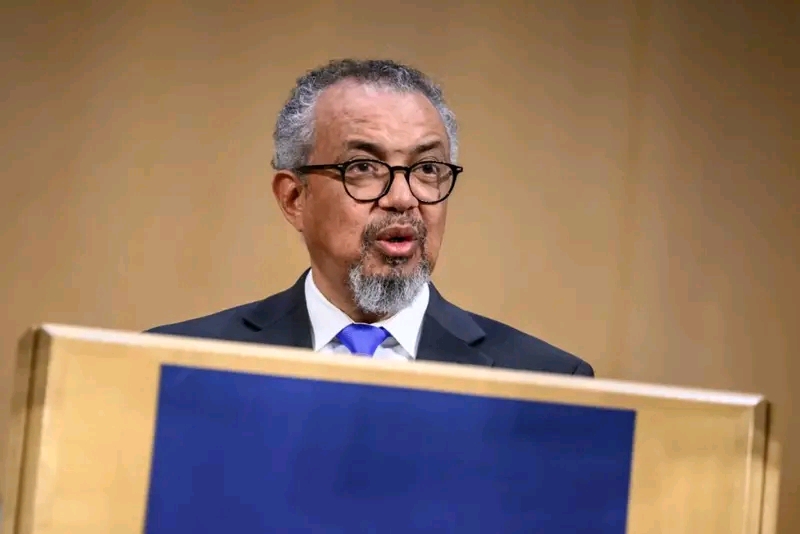
World Health Organization Director-General Tedros Adhanom Ghebreyesus arrived in the Democratic Republic of Congo’s capital on Thursday, touching down in Kinshasa to directly oversee the international response to a rapidly worsening Ebola outbreak that health officials have described as a crisis without easy solutions.
Tedros landed at N’djili International Airport in Kinshasa on Thursday, May 28, 2026, to witness efforts against an outbreak of a rare type of Ebola virus. His visit is expected to include meetings with Congolese health authorities before he travels to the conflict affected epicentre of the outbreak.
The epidemic is caused by the Bundibugyo ebola virus, a strain that may complicate response efforts, as existing Ebola treatments have been developed and tested against the Zaire ebolavirus. As of May 27, 2026, over 1,200 suspected and confirmed cases and at least 264 deaths had been reported.
On May 17, 2026, WHO determined that the Ebola disease caused by Bundibugyo virus in DRC and Uganda constitutes a Public Health Emergency of International Concern (PHEIC), as defined under the International Health Regulations. This is the 17th Ebola outbreak in the DRC since 1976.
WHO warned that eastern DRC faces a “catastrophic collision of disease and conflict” as the fast-spreading outbreak outpaces containment efforts in a region already battered by armed violence, mass displacement and acute hunger. Tedros said the Bundibugyo virus outbreak in Ituri province was spreading in an environment where insecurity, attacks on health facilities and population movements were making it “nearly impossible” to trace contacts and isolate cases. “We cannot build community trust or isolate the sick while bombs are falling,” he said.
The outbreak has spread across 11 health zones, with cases reported in North Kivu including in Butembo,Goma and in South Kivu. In neighbouring Uganda, health authorities have reported seven confirmed cases linked to the outbreak, including two healthcare workers and one confirmed death.
The Bundibugyo species of Ebola involved is one for which there is no vaccine or specific treatment, though work is ongoing to test promising candidates. The outbreak is occurring in a challenging context: a humanitarian crisis in a remote and densely populated area, combined with insecurity and high population and trade movements.
Nearly 10 million people across Ituri, North Kivu, South Kivu and Tanganyika are facing acute hunger between January and June 2026, according to IPC, the UN-backed global food security monitor. At the national level, an estimated 26.5 million people in DRC are experiencing high levels of acute food insecurity. “Hunger and disease are old companions,” Tedros said. “People weakened by hunger are far more vulnerable to infections.”
During his visit, Tedros appealed for an immediate ceasefire to allow humanitarian and medical teams safe passage into affected communities. WHO is also working with community leaders in Bunia to build trust and counter misinformation, developing public awareness materials adapted to local contexts and translated into local languages. “Community trust is the foundation of effective public health response,” said Julienne Ngoundoung Anoko, a WHO Community Engagement Officer deployed in Bunia. “Without community support, outbreak control measures cannot succeed.”
WHO is scaling up support to the governments of DRC and Uganda, strengthening surveillance, contact tracing, clinical preparedness and management, delivery of supplies and community engagement, and cross-border preparedness.