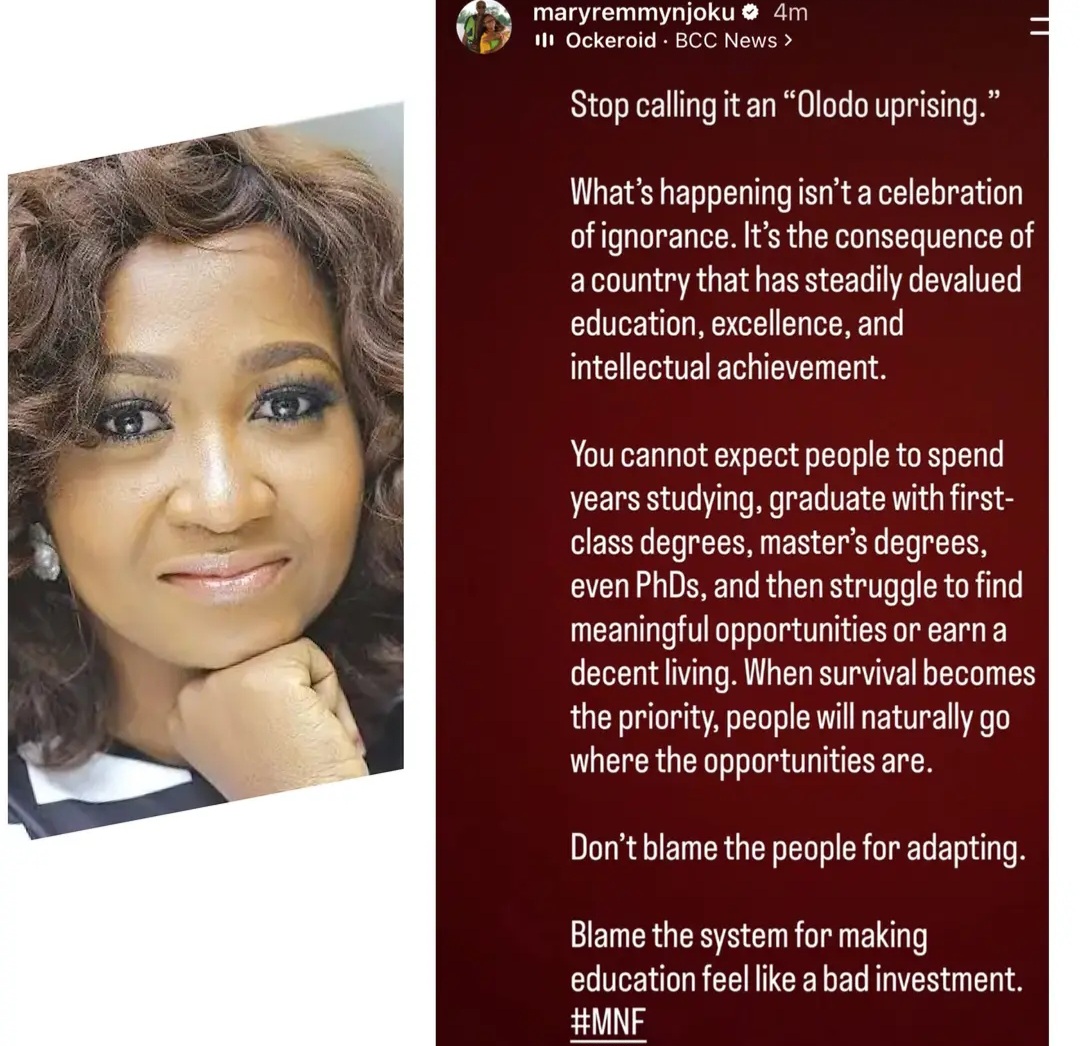
Nollywood actress and filmmaker Mary Remmy Njoku has called for a shift in the public narrative surrounding what she described as the “Olodo uprising,” arguing that the phenomenon is not a reflection of individual failure but rather the consequence of a system that has steadily undermined the value of education.
In a strongly worded statement shared on social media, the actress urged Nigerians to look beyond ridicule and confront the deeper structural issues affecting the country’s education sector.
“Stop calling it an ‘Olodo uprising.’ It’s the result of a system that has devalued education,” Njoku wrote, suggesting that the growing trend of anti-intellectualism and the dismissal of academic achievement is rooted in long-standing institutional failures rather than the shortcomings of individuals.
The actress maintained that years of inadequate investment in education, declining academic standards, and limited opportunities for young people have contributed to an environment where learning is increasingly undervalued. According to her, these systemic challenges have created conditions that discourage excellence while normalising ignorance.
Njoku argued that instead of mocking people perceived to lack knowledge or education, Nigerians should demand reforms that strengthen schools, improve access to quality learning, and restore confidence in the nation’s educational system.
She also stressed the importance of creating an environment where hard work, critical thinking, and intellectual achievement are recognised and rewarded. Without meaningful reforms, she warned, the country risks producing generations of young people who are ill-equipped to compete in an increasingly knowledge-driven global economy.
The actress further called on policymakers, parents, educators, and other stakeholders to work collectively toward rebuilding the education sector, describing it as one of the most critical foundations for national development.
Her remarks have sparked conversations across social media, with many users echoing her concerns about the declining value placed on education in parts of society. Others, however, argued that personal responsibility should remain an important part of the discussion, insisting that individuals must also take ownership of their learning regardless of systemic challenges.
The debate comes amid broader concerns over the state of education in Nigeria, including inadequate funding, deteriorating infrastructure, shortages of qualified teachers, prolonged industrial disputes, and the growing number of out-of-school children. Education experts have repeatedly warned that addressing these issues is essential to improving learning outcomes and equipping young Nigerians with the skills needed for economic growth and national development.
Njoku’s comments have added to the ongoing national conversation on the future of education, with many observers viewing her statement as a call for deeper reflection on the policies and societal attitudes that shape the country’s educational landscape.
As discussions continue online, the actress’s message has reinforced the argument that sustainable progress will depend not only on individual effort but also on a renewed commitment to building an education system that values knowledge, rewards excellence, and provides equal opportunities for all.