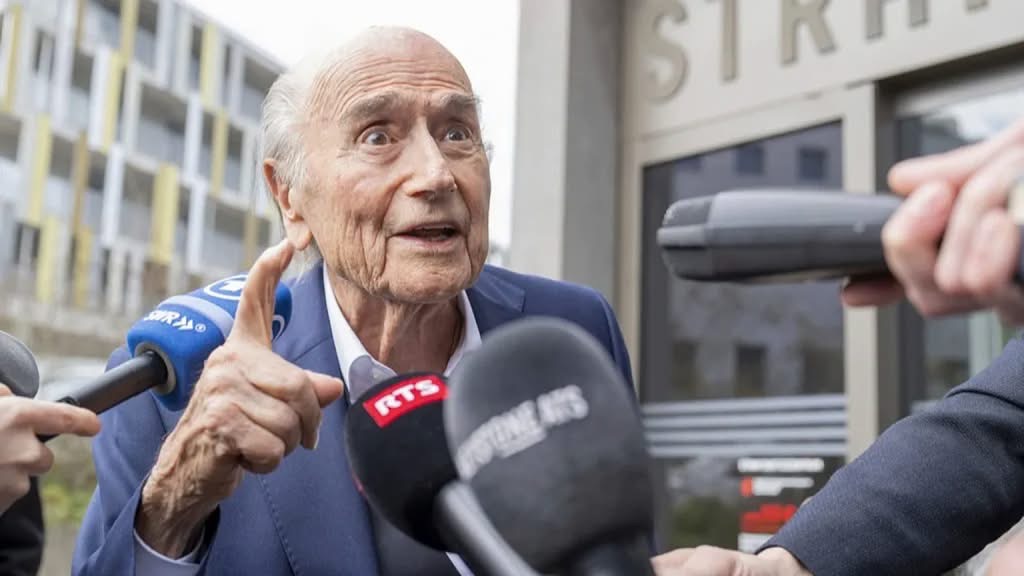
Former FIFA president Sepp Blatter has criticized FIFA over its reported decision to lift the automatic suspension of United States striker Folarin Balogun ahead of the FIFA World Cup Round of 16, warning that political influence should never interfere with football’s disciplinary processes.
Blatter’s remarks followed reports that FIFA reversed Balogun’s mandatory one-match ban after the player was sent off during the United States’ Round of 32 victory over Bosnia and Herzegovina.
According to the reports, the decision came after U.S. President Donald Trump reportedly appealed to FIFA President Gianni Infantino to review the disciplinary action.
If confirmed, the move would mark an unprecedented departure from longstanding FIFA World Cup regulations, under which players shown a straight red card automatically serve a one-match suspension.
Reacting to the development, Blatter questioned what he described as the growing influence of politics in football administration.
“Red cards are not overturned by political phone calls,” the former FIFA chief said. “They are overturned by rules, evidence and independent bodies. If a head of state can influence a disciplinary decision before a World Cup knockout match, then the question becomes: Quo Vadis, FIFA? Football must never become a playground for political power.”
The controversy stems from the United States’ Round of 32 encounter with Bosnia and Herzegovina, where Balogun was shown a straight red card in the 64th minute by referee Raphael Claus following a Video Assistant Referee (VAR) review for a challenge on Bosnian defender Tarik Muharemović.
Although many observers described the challenge as accidental, tournament regulations ordinarily require players dismissed with a straight red card to miss the following match.
Reports that FIFA converted the suspension into a one-year disciplinary probation have sparked widespread debate, particularly because the decision cleared Balogun to feature in the United States’ Round of 16 clash against Belgium national football team.
The reported ruling has drawn criticism from Belgian football authorities, who are said to be considering legal options over what they view as a breach of the principles of fairness and sporting integrity.
Belgium head coach Rudi Garcia also questioned the decision, saying it would represent an unprecedented moment in World Cup history if a red-card suspension were overturned in such circumstances.
On the other hand, United States manager Mauricio Pochettino defended Balogun’s availability, arguing that the original red card was harsh and that his team had already been sufficiently punished by playing with ten men for a significant portion of the match.
The controversy has intensified scrutiny of FIFA’s disciplinary procedures and reignited debate over the need for football’s governing bodies to remain independent of political influence.
As attention shifts to the Round of 16 encounter, the administrative dispute continues to generate discussion among football stakeholders over the integrity and consistency of decisions made during the world’s biggest football tournament.