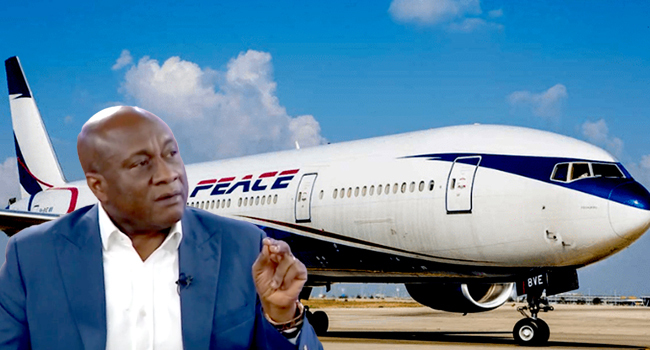
Air Peace has apologised to affected passengers after aviation unions disrupted the airline’s operations at the Lagos and Abuja airports on Tuesday, stranding travellers amid an escalating dispute over unremitted statutory ticket charges.
The disruption followed a picketing action by the National Union of Air Transport Employees (NUATE), the Air Transport Services Senior Staff Association of Nigeria (ATSSSAN), and the National Association of Aircraft Pilots and Engineers (NAAPE), backed by the Nigeria Labour Congress (NLC) and Trade Union Congress (TUC). The unions shut down Air Peace’s operations at the old terminal of the Murtala Muhammed Airport in Lagos and at the airline’s Abuja operations in the early hours of Tuesday.
The action stems from a long-running standoff over the five per cent Ticket Sales Charge (TSC), a statutory levy collected by airlines from passengers on behalf of the Nigerian Civil Aviation Authority (NCAA). The funds are meant to support key aviation agencies, including the NCAA, the Nigerian Airspace Management Agency (NAMA), the Nigerian Safety Investigation Bureau (NSIB), the Nigerian College of Aviation Technology (NCAT), and the Nigerian Meteorological Agency (NiMet).
The unions accuse Air Peace and other domestic carriers of withholding collected charges rather than remitting them, which they say has stalled the implementation of collective bargaining agreements already negotiated on behalf of aviation workers. They also allege that some airlines have made it difficult for staff to freely join trade unions, claiming workers fear discrimination or victimisation if they attempt to unionise.
The picketing followed months of escalating warnings. The unions first issued a 14-day ultimatum to defaulting airlines, followed by a seven-day notice that expired on August 3, 2026. A further notice of picketing was issued on August 4, with the unions stating they were prepared to strike “at any time without further notice.” In a statement, the unions described Tuesday’s action as “a gesture of restraint,” saying they had given the airlines “many weeks notice to address their grievances” before proceeding.
The disruption left several passengers stranded at the affected airports, many expressing frustration over the uncertainty surrounding their travel plans. One passenger said the delay had upended his schedule, while another said she had arrived early for a 6:30 a.m. flight but was left without clear information on when operations would resume.
Air Peace confirmed the disruption and apologised to affected customers, expressing regret over the inconvenience caused and thanking passengers for their patience as the airline worked with stakeholders to resolve the matter.
The Airline Operators of Nigeria (AON), the umbrella body representing domestic carriers, has rejected the unions’ claims, stating that the unions “neither represented nor spoke on behalf of the NCAA on matters relating to TSC remittances.” The AON said its members remained in active engagement with the NCAA through established regulatory channels and urged the unions to seek clarification through the appropriate authorities rather than disrupt flight operations.
Air Peace Chairman, Dr Allen Onyema, had earlier struck a defiant tone over the threatened industrial action, describing it as unprecedented. “We do not have any problem with any union, neither do we have any business with the unions. This is an aberration; it has never been heard before,” he said, arguing that statutory charge remittance issues were strictly a matter between airline operators and the NCAA.
Onyema, however, acknowledged that airlines did not wish to owe government agencies statutory payments, but argued that the current TSC collection framework was difficult to implement and required a comprehensive review. He proposed replacing the existing percentage-based model with a simpler, fixed charge per passenger to eliminate what he described as confusion over which components of airfares should attract the levy.
The standoff has raised concerns among industry stakeholders that the dispute could spread to other domestic carriers accused of similar TSC non-remittance. Aero Contractors Managing Director and CEO, Captain Ado Sanusi, has separately criticised the use of unions to enforce debt collection from airlines, describing it as an aberration, while acknowledging that the three-decade-old TSC framework is overdue for review.
The Nigerian Civil Aviation Authority has moved to mediate between the unions and airline operators in an effort to prevent further disruptions, as both sides continue to trade accusations over the funding of Nigeria’s aviation safety and regulatory agencies.
As of Tuesday, it remained unclear when normal operations would fully resume at the affected airports, with both the unions and Air Peace signalling that discussions were ongoing.