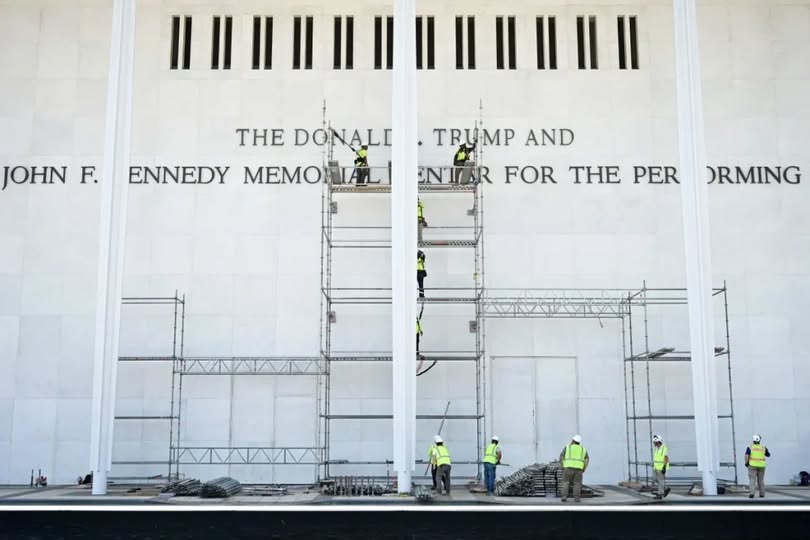
Workers have removed President Donald Trump’s name from the façade of the John F. Kennedy Center for the Performing Arts following a federal court order that ruled the venue’s recent renaming unlawful.
The operation was carried out in the early hours of Saturday, with crews dismantling the signage under scaffolding and protective coverings after weather-related delays caused by thunderstorms in the U.S. capital. By later in the day, officials confirmed that all physical references to Trump’s name had been removed from the building and surrounding grounds.
The development marks the latest chapter in a legal dispute that began after the Kennedy Center’s board voted last year to rebrand the institution, adding Trump’s name to the venue’s title. The decision sparked widespread criticism from members of the arts community, the Kennedy family, and several lawmakers, who argued that the move exceeded the board’s authority.
The controversy eventually reached the courts, where a federal judge ruled that the board lacked the legal power to alter the name of the federally established cultural institution. In the ruling, the court stated that only Congress has the authority to change the center’s official name.
The court also directed officials to remove Trump’s name from all promotional materials, websites, and other public-facing platforms associated with the institution.
Efforts by government lawyers to delay or overturn the order were unsuccessful. Appeals seeking emergency relief were rejected by both the district court and an appellate panel, allowing the removal process to proceed.
Crowds gathered outside the Kennedy Center during the overnight operation, with some demonstrators welcoming the court’s decision and celebrating as workers removed the signage.
In addition to the name change dispute, the court also blocked plans to temporarily close the Kennedy Center for a major renovation project that had been scheduled to begin later this year.
The Kennedy Center has since restored its original branding across its digital platforms and official communications, returning the institution to its longstanding identity as a memorial to former U.S. President John F. Kennedy.
The ruling is expected to have wider implications for the governance of federally chartered cultural institutions and the limits of administrative authority in altering their identities.