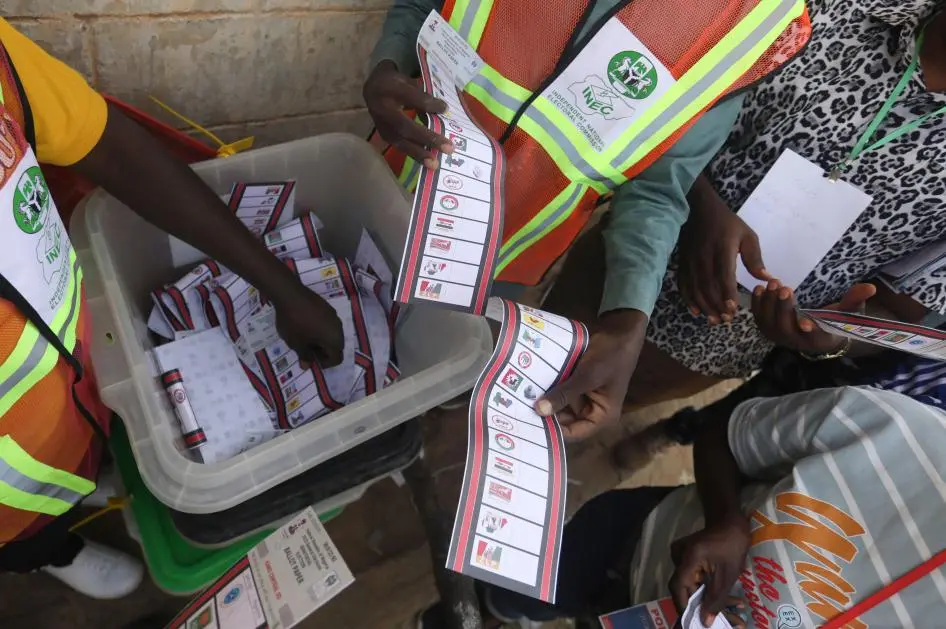
With Nigeria’s 2027 presidential election approaching, the country’s political landscape is witnessing major defections, coalition-building efforts, and internal party disputes, signaling an early and intense contest among the nation’s leading political forces.
The shifting alliances have accelerated following adjustments to the electoral timetable by the Independent National Electoral Commission (INEC) under the Electoral Act 2026, which compressed political activities and forced parties to begin strategic positioning earlier than usual.
The ruling All Progressives Congress (APC) has continued to strengthen its national influence through a series of high-profile defections involving governors, lawmakers, and political stakeholders from opposition parties.
Recent political crossings from the Peoples Democratic Party (PDP) and smaller parties have further increased the APC’s control at the state level, reinforcing its dominance ahead of the next general election.
However, the ruling party is also facing growing internal tension following the conclusion of recent party primaries in several states. Reports of grievances among aspirants and party loyalists dissatisfied with the outcome of the primaries have triggered fresh political uncertainty within sections of the APC.
The fallout from the primaries has reportedly sparked another wave of defections, with some aggrieved politicians and their supporters reconsidering their future within the party ahead of the campaign season.
Political observers say the development reflects a recurring pattern in Nigerian politics where internal party disputes often reshape alliances and influence electoral calculations.
Meanwhile, opposition coalition efforts have taken a more concrete shape with the emergence of the Nigeria Democratic Congress (NDC) as a major political platform ahead of the 2027 elections.
Former Labour Party presidential candidate Peter Obi and New Nigeria Peoples Party (NNPP) leader Rabiu Musa Kwankwaso have officially defected to the NDC, a move analysts say could significantly reshape opposition politics in Nigeria.
The two political heavyweights are expected to play central roles in the party’s presidential primary election, which is already generating nationwide attention as the NDC positions itself as a formidable alternative to the APC.
Political analysts say the Obi-Kwankwaso alliance could alter opposition dynamics by combining strong youth-driven support, urban voter appeal, and northern political influence under a broader coalition arrangement.
The development has also intensified political calculations across opposition circles, particularly following the outcome of the African Democratic Congress (ADC) presidential primary.
Former Vice President Atiku Abubakar has emerged as the presidential candidate of the African Democratic Congress (ADC) after securing victory in the party’s presidential primary election.
However, the outcome has already sparked controversy within the party, with former Rivers State Governor Rotimi Amaechi reportedly rejecting the result and raising concerns over the conduct of the primary process.
Political observers say the dispute could deepen divisions within the ADC at a critical period when opposition parties are attempting to consolidate support ahead of the general election.
The emergence of multiple opposition platforms — including the NDC and ADC — has further complicated the political landscape, raising questions about whether opposition forces will eventually unite or remain fragmented heading into 2027.
Analysts say economic conditions are likely to remain central to the 2027 political contest, with inflation, fuel prices, unemployment, and rising living costs already dominating public discussions.
Opposition parties are expected to focus heavily on economic hardship, governance spending, and declining purchasing power, while the APC is likely to defend its policies by pointing to ongoing infrastructure projects, economic reforms, and long-term recovery plans.
Public frustration over inflation and governance costs has continued to shape political sentiment across the country, particularly among urban voters and young Nigerians facing rising transport fares, expensive food prices, and limited employment opportunities.
Beyond public declarations, political consultations involving regional leaders, influential stakeholders, and power brokers are intensifying behind closed doors.
Observers say endorsements from socio-cultural groups, regional blocs, and influential political figures may play a significant role in determining the structure of alliances ahead of the official campaign season.
As preparations continue, analysts believe the defining question ahead of 2027 remains whether opposition parties can overcome internal rivalries and personal ambitions to form a credible coalition, or whether continued fragmentation will strengthen the APC’s path toward retaining power.