

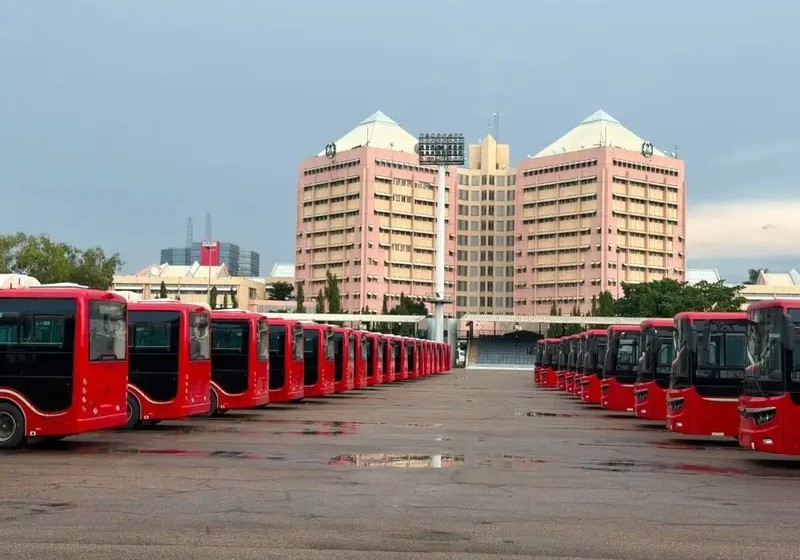
The Federal Government has inaugurated a fleet of 100 electric mass transit buses under the Renewed Hope Mass Transit Programme as part of efforts to provide safer, more affordable and reliable transportation for federal civil servants.
The buses were inaugurated on Wednesday at Eagle Square in Abuja by the Head of the Civil Service of the Federation (HCSF), Didi Walson-Jack.
However, only 37 of the 100 buses have so far been delivered, with the remaining vehicles expected to be deployed as the programme progresses. The initial buses will operate on selected routes during a pilot phase before the scheme is expanded to other locations, including Federal Secretariats across the country.
Walson-Jack said the initiative was designed to address some of the challenges associated with daily commuting, noting that transportation costs affect workers’ finances, safety, punctuality and productivity.
She described the programme as a significant welfare intervention for civil servants and said it would help reduce the financial burden of commuting while providing workers with a safer and more dependable means of getting to and from work.
The HCSF, whose tenure ends on Thursday, described the initiative as her “parting gift” to federal civil servants, saying she was pleased to see the project become operational before the end of her tenure
She urged civil servants to protect the buses and treat them as public assets, stressing that their sustainability would depend partly on proper use and maintenance.
According to her, a special-purpose vehicle has been established to oversee the management, maintenance and long-term sustainability of the buses.8
The acquisition of the buses was made possible through the Renewed Hope Infrastructure Development Fund, with the Federal Government presenting the programme as part of its broader efforts to improve workers’ welfare and translate its economic reforms into practical benefits.
The Minister of State for Industry, Trade and Investment, John Owan Enoh, said the programme represented more than a transportation intervention, describing it as a combination of workers’ welfare, productivity, technology and industrial development.
Enoh said the deployment of electric buses would provide federal workers with more affordable transportation while supporting the government’s wider efforts to develop Nigeria’s automotive industry.
Reports on the programme also indicate that the buses were assembled in Nigeria, linking the initiative to efforts to strengthen local automotive manufacturing and retain economic value within the country.
The Federal Government said the pilot phase would be monitored before a broader rollout, with officials expected to establish clear routes, schedules, maintenance arrangements and safety measures.
The initiative comes amid continued concerns over transportation costs following the removal of petrol subsidy and the wider rise in the cost of living, which have increased commuting expenses for many Nigerian workers.
The government hopes the electric bus programme will ease some of the pressure on federal civil servants while improving punctuality, safety and productivity across the public service.