
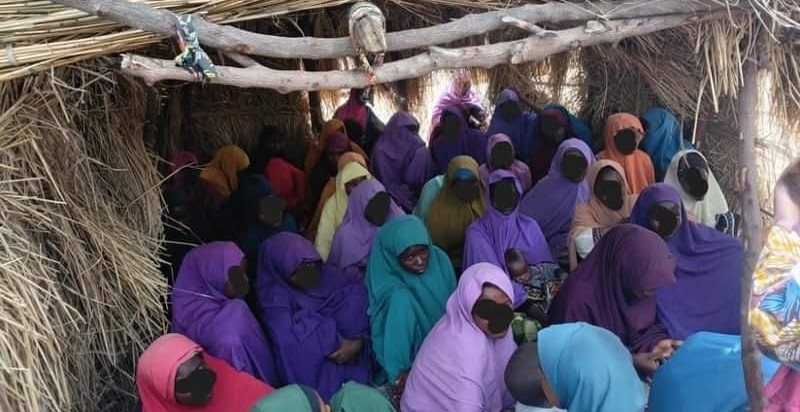
Young women who were married off as teenagers in a Maiduguri community are appealing to the Borno State Government to expand access to education, saying formal schooling would help them rebuild their lives, better support their children, and contribute more meaningfully to society.
Speaking during a media engagement organised by the Participatory Communication for Gender Development Initiative in Maiduguri on Sunday, women from the Tashan Kangele community, many of whom were married between the ages of 13 and 16 described their desire for a second chance at education that early marriage had denied them.
Among them was Fatima Umar, 22, who was married at 16 and later got divorced. She explained that her marriage broke down after she asked her husband to allow her to attend school, inspired by her co-wife, a working-class woman. “I got divorced because my husband got married to a second wife who is a working-class lady. Impressed by my co-wife’s achievement, I told my husband that I want to go to school to be working like my co-wife. That led to a fuss which subsequently separated us,” she said. “I want to go to school. I crave education,” she added, expressing hope of completing her studies before turning 30.
Maryam Abba, 18, who was married at 14 and now has two children, said she has never had the opportunity to attend school. “I am 18 years old. I got married at the age of 14. I now have two children. I have never been to school. If there is a means for me to go back to school, I will be glad because it will help me to care for my children and for them to also be educated,” she said.
Another woman, Aisha Usman, said she was married at 13 following the death of her mother, and that financial constraints had since prevented her from returning to school.
Beyond financial and social barriers, the women said many of them were simply unaware that adult and second-chance learning centres existed in the state. Abba noted that while she was aware schools exist for married women, she did not know whether such a facility was available in her own town.
The women lamented that even where such programmes exist, proximity remains a major obstacle, with long distances to available centres discouraging attendance. They called on the government to improve access by raising public awareness of existing programmes, establishing more learning centres closer to their communities, and introducing measures to address the mobility challenges that keep many of them from attending.
The appeal from Tashan Kangele reflects a wider, long-documented struggle over girls’ education in Borno State, a region that has for over a decade grappled with the effects of the Boko Haram insurgency, a group whose name roughly translates to “Western education is forbidden” and which has historically targeted girls’ access to schooling, most notably in the 2014 abduction of 276 schoolgirls from Chibok.
Beyond insurgency-related disruption, stakeholders have repeatedly flagged poverty and entrenched cultural norms around early marriage as key drivers keeping girls out of school across the state. In some documented cases, economic hardship including family displacement caused by government demolitions has directly preceded decisions by parents to marry off school-age daughters.
In response to these challenges, the Borno State Government has partnered with organisations including the World Bank and the Malala Foundation on initiatives such as the Adolescent Girls Initiative for Learning and Empowerment (AGILE) and Better Education Service Delivery for All (BESDA), while also working with civil society groups to strengthen its Gender-Responsive Education Sector Plan across local government areas. Despite these interventions, advocates say numerous out-of-school girls remain across the state, including in displacement camps and on city streets.
For the women of Tashan Kangele, the appeal is a direct and personal one: an opportunity to complete an education that early marriage interrupted, both for their own advancement and for the sake of their children. As Abba put it, returning to school would not only help her provide for her family but would also allow her to help ensure her own children are educated, potentially breaking a cycle that has shaped her own life and that of many women in her community.