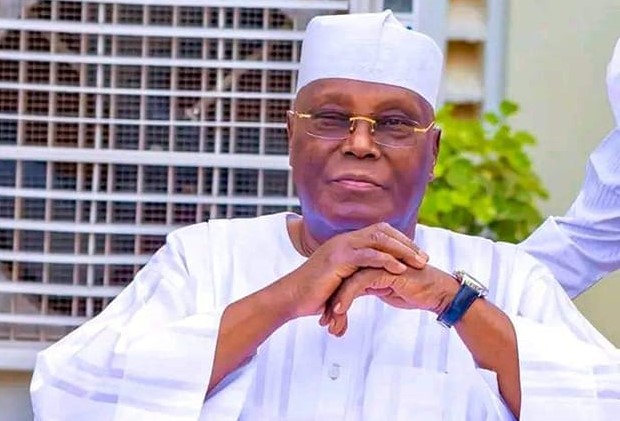
Former Vice President Atiku Abubakar personally appeared at the Registry of the Federal High Court in Abuja on Friday, where he swore to an affidavit supporting a lawsuit seeking to bar President Bola Ahmed Tinubu from contesting the 2027 presidential election.
Atiku, the presidential candidate of the African Democratic Congress (ADC), filed the suit alongside the party against Tinubu, the All Progressives Congress (APC) and the Independent National Electoral Commission (INEC). His personal appearance at the registry to swear to the facts contained in the affidavit was described as a deliberate step to formally stand behind the allegations raised in the case.
The suit centers on Section 137(1)(j) of the 1999 Constitution, which addresses the presentation of forged certificates by presidential candidates. Atiku’s legal team is asking the court to examine a National Youth Service Corps (NYSC) certificate allegedly submitted to INEC in Tinubu’s name, arguing that the document bears the name “Tinubu Bola Adekunle” rather than “Bola Ahmed Tinubu.” The plaintiffs are questioning whether the certificate was genuinely issued to the president and whether the discrepancy in names affects his qualification to have contested the 2023 election and to contest again in 2027.
The legal action also seeks access to Tinubu’s Form CF001, the personal particulars form submitted to INEC, for both the 2023 and 2027 election cycles. Atiku said INEC had been formally notified to produce certified copies of the relevant documents but that the records were not made available to him before the case was filed. He is asking the court to compel INEC, as custodian of the records, to present the documents so their authenticity can be judicially examined.
Beyond the certificate dispute, Atiku’s legal team is also challenging provisions of the Electoral Act 2026, arguing that certain sections may improperly restrict the ability to challenge a presidential candidate’s qualifications before an election takes place. The plaintiffs contend that an ordinary act of the National Assembly cannot override a right or condition expressly established by the Constitution, and they are asking the court to rule on whether those provisions can lawfully bar their challenge to Tinubu’s eligibility under Section 137(1)(j).
The suit asks the Federal High Court to disqualify both Tinubu and the APC from the 2027 presidential race if the allegations are proven.
Atiku and the ADC are represented by Edwin Inegedu, SAN, and Joseph Onu Silas, who said their legal team had reviewed the relevant laws before filing the case. Tinubu, the APC and INEC are expected to respond once formally served with the court processes. The court will need to determine whether the suit can proceed and whether the constitutional and electoral questions it raises have legal merit.
The case is the latest chapter in a long-running dispute between Atiku and Tinubu over the president’s academic credentials, dating back to the 2023 election. Atiku, who ran as the Peoples Democratic Party’s candidate that year, previously obtained a U.S. federal court order compelling Chicago State University to release Tinubu’s academic records, which he argued contained inconsistencies. Both the Presidential Election Petition Court and the Supreme Court subsequently dismissed challenges to Tinubu’s qualification and upheld his election.
When INEC published presidential candidates’ credentials for the 2027 race last month, Tinubu’s submission again omitted primary and secondary school qualifications, listing only his 1979 business administration degree from Chicago State University, alongside his NYSC certificate, an omission that had already reignited public debate over his eligibility before Friday’s court filing.
A separate suit filed in June by the Centre for Reform and Public Advocacy at the Federal High Court in Kano, also alleging certificate forgery against Tinubu, remains pending, with a hearing date fixed for September 21.