
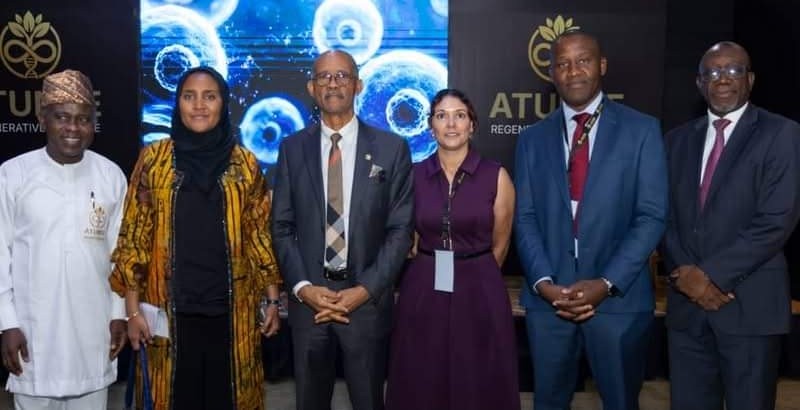
Dangote Group President Aliko Dangote and Lagos State Governor Babajide Sanwo-Olu have thrown their weight behind efforts to build Nigeria’s capacity to manufacture advanced medical therapies locally, arguing that the country must reduce its dependence on imported healthcare products and stem the growing loss of patients, capital and medical expertise to foreign nations.
Their endorsements came at the launch of Atunse Healthcare in Lagos, which unveiled plans to manufacture and distribute advanced regenerative biologics within Nigeria, train local scientists and clinicians, and expand access to specialised treatments, an effort aimed at curbing medical tourism. The launch took place at the African Regenerative Medicine and Longevity Summit in Lagos on August 7, 2026.
Delivering the keynote address, Dangote represented by Fatima Aliko Dangote, Group Executive Director of Commercial Operations for Oil & Gas at Dangote Industries said the COVID-19 pandemic had exposed the risks of Africa’s heavy reliance on imported medical products and technologies. She said the pandemic underscored the need for countries to build the capacity to respond to health emergencies without excessive dependence on external sources, and called for Nigeria to strengthen its healthcare infrastructure, local manufacturing capabilities and human capital.
“It should be built where public focus meets private capability, where policy creates an enabling environment, and enterprise brings execution, investment, innovation and scale,” Dangote said.
Lagos State Commissioner for Health, Prof. Akin Abayomi, who represented Governor Sanwo-Olu, described regenerative medicine as one of healthcare’s most promising frontiers and said initiatives like Atunse could help reverse Nigeria’s brain drain by drawing experienced doctors and scientists back from abroad.
“We need our own experienced specialists back to do this,” Sanwo-Olu said, according to remarks delivered on his behalf. “When we start seeing initiatives like this, it starts to encourage our own experienced specialists to come back home. This is the kind of initiative that is attractive to doctors and scientists doing great things abroad.”
Abayomi added that Lagos State is separately strengthening its digital health infrastructure through its Smart Health Information Platform (SHIP), aimed at integrating health data, technology, specialists and private-sector investment to improve healthcare planning and delivery.
Prof. Kamar T. Adeleke, President and Chairman of Atunse Healthcare, said the company was built around four simultaneous capabilities: clinical delivery, advanced biomanufacturing, research and clinical translation, and regulatory capability. Its clinical delivery will be anchored by a treatment centre in Nigeria, while its biomanufacturing arm is working toward cGMP-grade (current Good Manufacturing Practice) production of advanced biologics domestically. The company’s longer-term roadmap extends to vaccine production and, eventually, cell and gene therapies.
Adeleke stressed that local manufacturing must go hand-in-hand with developing homegrown expertise and regulatory oversight. “A country which manufactures without training its own scientists, and without governing its own standards, has substituted one dependency for another,” he said.
Atunse’s Chief Executive Officer, Dr Sola Oluwole, framed the stakes in broader terms, noting that medical tourism costs Nigeria far more than money. The company cited figures putting Nigeria’s annual medical tourism bill at approximately $2.39 billion.
The company said it is currently working with four investigational biologics platforms developed and manufactured by KweHealth branded AVEXO, KH-1814, AIOVA and NKIRA which it stressed are being used strictly within approved regulatory and ethical frameworks and with informed consent. Atunse emphasised that none of the platforms are approved for any medical indication and that it makes no claims regarding their safety or efficacy at this stage.
The launch highlighted the scale of Africa’s dependence on imported medical products. According to figures cited by Atunse, Africa imports approximately 99 percent of the vaccines and more than 95 percent of the medicines it uses, while producing less than 1 percent of its own vaccine supply. The African Union has set a target for the continent to produce 60 percent of its health products locally by 2040.
Representing the Director-General of Nigeria’s National Agency for Food and Drug Administration and Control (NAFDAC), Mrs Khadijah Ade-Abolade of the agency’s Vaccine, Biologics, and Medical Devices Registration and Regulation Directorate also spoke at the event, noting that the growth of regenerative medicine presents both opportunities and new regulatory demands as Nigeria seeks to build oversight capacity for a more advanced biologics industry.
With its Lagos launch, Atunse Healthcare says it is laying the groundwork for a future in which advanced medicine in Africa is not solely imported, but also invented, manufactured and governed on the continent.