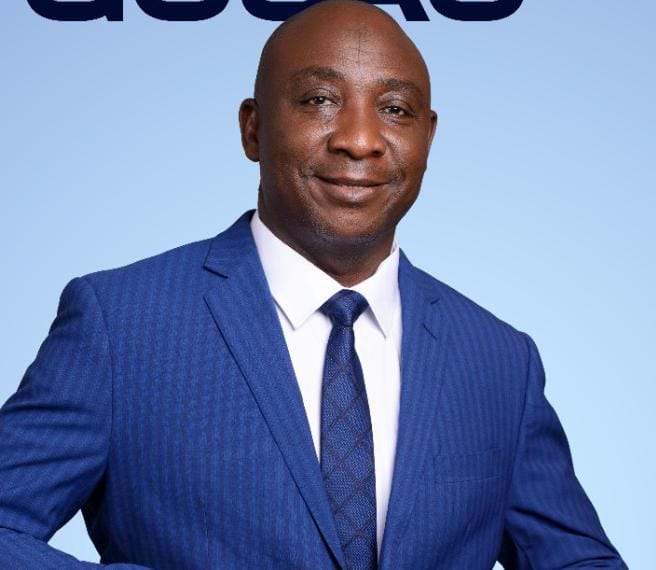
The Nigeria Football Federation (NFF) has been thrown into a leadership crisis following the resignation of its President, Ibrahim Musa Gusau, General Secretary Mohammed Sanusi and members of the federation’s Executive Committee.
Gusau confirmed his resignation on Thursday, August 27, 2026, at a press conference in Abuja, bringing an end to his tenure nearly four years after he was elected NFF president in September 2022. The NFF subsequently confirmed that the Executive Committee members had also resigned.
Gusau said his decision followed consultations with his family, friends and stakeholders in Nigerian football. He explained that he stepped down in what he described as the overriding interest of Nigerian football and to pave the way for a comprehensive reform of the sport.
“My resignation is intended to give way to a comprehensive and orderly reform process aimed at addressing the longstanding institutional, governance and developmental challenges confronting Nigerian football,” Gusau said.
The mass resignation comes amid intense criticism of the administration following a series of disappointing performances by Nigeria’s national teams.
The Super Eagles failed to qualify for the 2026 FIFA World Cup, while the Super Falcons recently missed qualification for the 2027 FIFA Women’s World Cup. The Falcons’ failure ended Nigeria’s record of appearing at every edition of the women’s World Cup since the tournament began in 1991.
Also read: Nigerian football faces major overhaul as Tinubu orders reforms
Nigeria’s age-grade teams have also experienced qualification setbacks, adding to concerns about the state of football development and administration in the country.
The leadership shake-up comes as the NFF faces scrutiny over the management of funds provided by the Federal Government.
The Economic and Financial Crimes Commission (EFCC) has confirmed that its investigation into the utilisation of a ₦12 billion intervention fund released to the NFF is ongoing. The money was approved to help clear outstanding wages and bonuses owed to players and officials of Nigeria’s national teams.
The development has heightened calls for greater accountability and transparency in the administration of Nigerian football.
Despite the criticism, Gusau defended his administration’s record at his final press conference, pointing to programmes in coaching education, domestic league administration, refereeing and infrastructure development.
He said the NFF had conducted several coaching courses and introduced younger referees into the system, while also working on infrastructure and permanent accommodation and training facilities for the national teams.
The resignations have also created uncertainty around the NFF’s electoral process, with the federation’s elective congress previously scheduled for September 27 in Lafia, Nasarawa State.
The National Sports Commission has since endorsed Dr Emmanuel Ikpeme, a former NFF Deputy General Secretary, to oversee the federation’s secretariat as interim General Secretary. Ademola Olajire, the former Director of Media and Communications, has also been appointed interim Deputy General Secretary.
The ongoing electoral process has been suspended, with the commission directing that a fresh process should begin after comprehensive reforms are completed in consultation with FIFA, the Confederation of African Football (CAF), the government and other stakeholders.
The latest development follows President Bola Tinubu’s directive for a comprehensive reform of Nigerian football, including its governance, administration and development structures.
Gusau, who said he remained committed to Nigerian football, maintained that his experience and relationships within African football could still be useful to the country whenever his contribution was required.
The mass resignation now leaves Nigerian football facing a major transition, with stakeholders expected to determine a new administrative structure and roadmap for the sport.