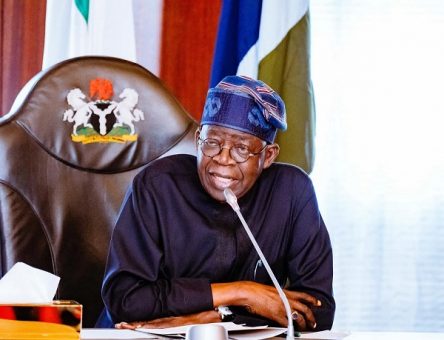
President Bola Ahmed Tinubu has directed a comprehensive reform of Nigerian football following the resignation of Nigeria Football Federation (NFF) President Ibrahim Musa Gusau, General Secretary Mohammed Sanusi and members of the federation’s Executive Committee.
The directive was announced on Thursday by Bayo Onanuga, Special Adviser to the President on Information and Strategy, amid mounting concerns over the administration and performance of Nigerian football.
The development came on the same day the NFF leadership announced its resignation, with the federation saying the decision was intended to pave the way for a “comprehensive and orderly reform process” to address longstanding institutional, governance and developmental challenges.
Tinubu said the reform was necessary to address Nigeria’s repeated failure to qualify for major regional, continental and global competitions.
The President identified governance, administration, stakeholder representation, player development pathways, domestic competitions and accountability as key areas requiring attention.
According to the presidential statement, Tinubu noted that football, despite being Nigeria’s most popular sport and receiving significant public support and investment, had continued to struggle because of structural weaknesses within the system.
The President also directed Shehu Dikko, Chairman of the National Sports Commission (NSC), to work with the NFF Secretariat and relevant football stakeholders to ensure continuity in essential football administration while facilitating broad consultations on the reform process.
The consultations are expected to involve relevant stakeholders within the Nigerian football community, as well as appropriate engagement with the Federation Internationale de Football Association (FIFA) and the Confederation of African Football (CAF), while safeguarding Nigeria’s obligations under the international football framework.
The crisis follows a series of setbacks involving Nigeria’s national teams. The Super Eagles failed to qualify for the 2026 FIFA World Cup, while the Super Falcons recently missed out on qualification for the 2027 Women’s World Cup for the first time since the tournament began in 1991.
The NFF leadership’s resignation also comes about a month before the federation’s scheduled elective congress on September 27 in Lafia, Nasarawa State.
The shake-up has intensified calls for changes in the administration of Nigerian football, with former Super Eagles captain John Obi Mikel among those who had recently called for fresh leadership at the federation.
Tinubu said the reform should ensure that Nigeria’s abundant football talent, public passion and resources are matched by stronger institutions and sustained performance.
The President’s directive is expected to set the stage for wider consultations on the future structure and administration of Nigerian football, as stakeholders seek to restore the country’s competitiveness on the international stage.