
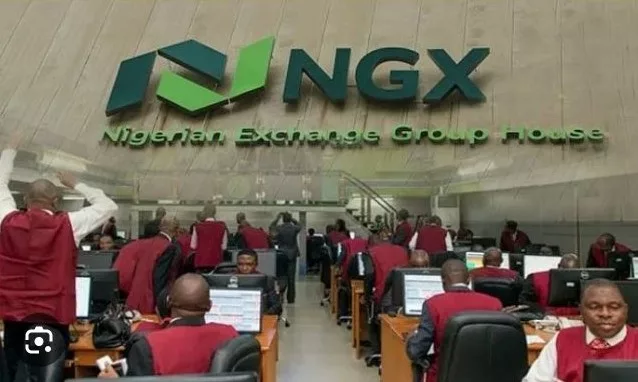
The Nigerian Exchange (NGX) recorded a total turnover of N111.48 billion in equities during the three-day trading week, representing a decline of about 31 per cent compared to the previous week’s performance.
According to the NGX weekly market report, investors traded 2.398 billion shares valued at N111.48 billion in 241,313 deals during the week. This was lower than the 3.875 billion shares worth N161.76 billion exchanged in 334,745 deals in the preceding week.
Trading activities were shortened after the Federal Government declared Wednesday and Thursday public holidays to mark the Eid-el-Kabir celebrations, leaving the market open for only three trading sessions during the week.
The Financial Services Industry led market activity, accounting for 1.656 billion shares valued at N48.23 billion in 94,812 deals. The Services Industry followed with 265.45 million shares worth N4.53 billion, while the Information and Communications Technology (ICT) sector recorded 101.85 million shares valued at N9.16 billion.
Among individual stocks, trading in shares of Fidelity Bank Plc, Access Holdings Plc and The Initiates Plc dominated the market, accounting for 903.68 million shares worth N19.23 billion in 22,238 deals. The three equities contributed 37.69 per cent of total trading volume and 17.25 per cent of total market value during the week.
Despite the decline in overall turnover, the benchmark NGX All-Share Index (ASI) rose by 0.27 per cent to close at 250,385.47 points, while market capitalisation appreciated to N160.51 trillion.
Exchange-traded products (ETPs) also recorded lower activity, with 4.69 million units worth N569.77 million traded in 5,505 deals, compared to 5.98 million units valued at N815.90 million in the previous week. Similarly, bond market transactions fell to 135,590 units worth N157.01 million in 26 deals from 166,770 units valued at N169.82 million recorded a week earlier.
Market analysts attributed the reduced trading volume partly to the shortened trading week and cautious investor sentiment ahead of the Eid-el-Kabir holidays, which had already triggered sell-offs and lower market participation in the days leading up to the break.