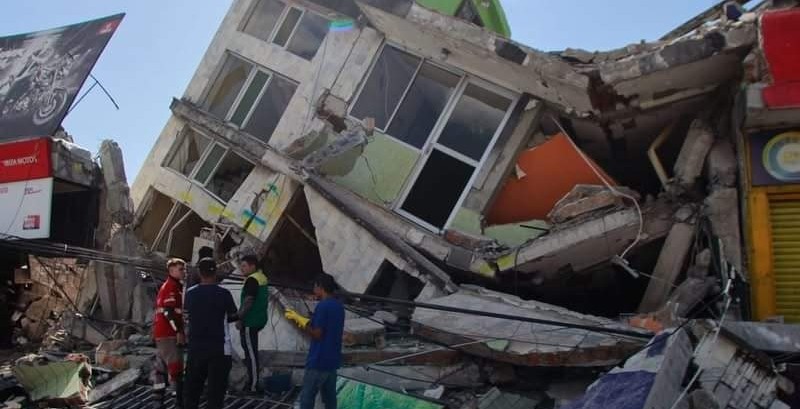
Colombia’s government has declared a national disaster after a powerful 7.4-magnitude earthquake tore through the western part of the country early Monday, killing at least 132 people, injuring hundreds more, and collapsing dozens of buildings across several major cities.
The quake struck at 7:34 a.m. local time, with its epicenter about five kilometers east of San José del Palmar in Colombia’s Chocó department roughly 250 miles (400 kilometers) west of the capital, Bogotá according to the US Geological Survey. The tremor originated at a depth of approximately 107 kilometers (66 miles).
According to Colombia’s nonprofit Association of Capital Cities, which has been tracking casualty figures, at least 132 people have died and 570 have been injured, including 60 deaths in the western city of Pereira alone. The Colombian Geological Service described it as the country’s strongest earthquake recorded in the 21st century.
President Abelardo De La Espriella, who was recently inaugurated, said he had personally taken charge of the government’s response and declared a national disaster to coordinate emergency mobilization efforts. Speaking at a national briefing, he said an estimated 700 people had been injured in the quake and roughly 5,000 homes had been damaged or destroyed. “You are not alone,” he told citizens, according to reports of his remarks. “The first priority is rescuing the people trapped under the rubble.”
The hardest-hit cities which are Pereira, Cali, Quibdó, Manizales and Armenia, all remain under “red alert,” Colombia’s highest disaster threat level. Officials say 86 buildings have collapsed nationwide, and seven airports have suspended operations. In Cali, the country’s third-largest city, the mayor’s office reported at least 188 people missing, and rescue teams have been searching through the wreckage of destroyed structures. Among the buildings that collapsed were the pediatric and neonatal sections of a hospital in Cali.
In Pereira, 16 people were trapped for six hours in an aerial cable car system before being evacuated. Roads, transportation networks, aqueducts, energy supplies and telecommunications have all been disrupted in the worst-affected areas. The government has deployed soldiers to assist emergency response efforts.
At least 21 aftershocks followed the initial quake within hours, and tremors were felt as far away as Bogotá, as well as in neighboring Ecuador, Panama and Venezuela including in the Venezuelan border state of Táchira and the city of Barquisimeto.
The United States has pledged $15.5 million to support Colombia’s emergency response, funding shelter, food, protection services and earthquake damage assessments, the State Department announced Monday night. The US Embassy in Bogotá said it was “actively assisting” Americans affected by the disaster; hundreds of thousands of US tourists visit Colombia annually, making them the largest group of foreign visitors to the country.
Monday’s earthquake comes less than two months after Venezuela was struck by a pair of devastating earthquakes in June measuring 7.2 and 7.5 in magnitude that killed more than 6,000 people, with the heaviest casualties concentrated along the coast near Caracas.
Northwestern University seismologist Suzan van der Lee told Reuters that the quake’s magnitude, inland location and strike-slip motion may have intensified shaking in populated valleys despite its considerable depth. “This one was far below the crust, and in theory, it shouldn’t cause as much shaking,” she said. “At this magnitude, it did actually cause a lot of shaking.”
Colombia sits along the seismically active Pacific Ring of Fire and near several major tectonic fault systems, making it one of South America’s most earthquake-prone nations. While minor tremors, known locally as “temblores,” are common, quakes above magnitude 6.0 are rare. The last comparable disaster was a magnitude 6.2 earthquake near the city of Armenia in 1999, which killed more than 1,100 people.
Rescue operations are ongoing, and officials have cautioned that casualty figures are likely to rise as search and recovery efforts continue.