
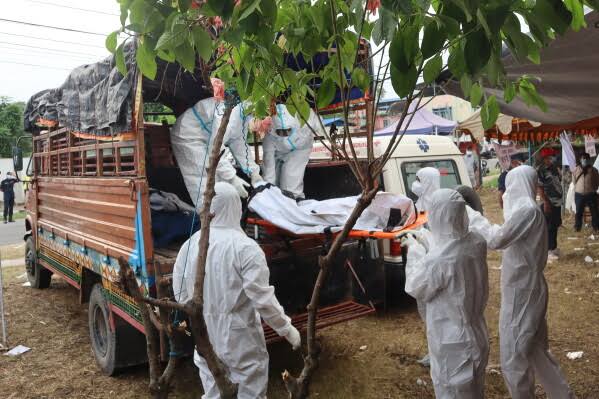
Nepal has begun temporarily burying unidentified victims of a catastrophic flash flood and mudslide as rescue teams continue searching for thousands of people still missing after the disaster struck the Himalayan region.
The disaster, triggered by a glacier collapse near the Nepal-China border, unleashed torrents of water and debris that swept through communities, destroying homes, roads, bridges and other infrastructure.
By Sunday, Nepal’s reported death toll had risen to around 781, while more than 2,500 people remained missing, according to Reuters. Across the wider Nepal-China disaster zone, the number of confirmed deaths was approaching 800, with thousands still unaccounted for.
The scale of the disaster has overwhelmed hospitals and morgues in affected areas, leaving authorities struggling to accommodate the large number of bodies being recovered.
In Chitwan district, authorities began temporary mass burials at Devghat forest for unidentified victims whose remains had deteriorated after days in the water. Reuters reported that 96 unidentified bodies were buried on Saturday, with more than 100 additional victims expected to be buried as recovery operations continue.
Officials say the burials are being carried out because of the limited capacity of morgues and the condition of the bodies, while efforts are being made to preserve information that could eventually allow families to identify and reclaim the remains.
Medical and forensic teams are documenting the bodies, collecting DNA samples and recording burial locations. The measures are intended to give relatives a chance of identifying loved ones later, even after temporary burial.
The situation has nevertheless caused distress among grieving families, many of whom continue to travel to identification centres hoping to find relatives who disappeared when the floods struck.
At the Chitwan Expo Centre, families have gathered to inspect recovered belongings and seek information about missing relatives. Many are facing the painful uncertainty of not knowing whether their loved ones survived, were swept away or are among the unidentified dead.
The disaster has also placed enormous pressure on Nepal’s emergency services. Hospitals and morgues have struggled to cope with the number of casualties, while difficult terrain, damaged roads and continuing flood risks have complicated rescue and recovery operations.
Search teams are using helicopters, drones and heavy machinery in an effort to locate survivors and recover bodies from areas buried under mud and debris. In one particularly difficult operation, rescuers have been searching for people believed to be trapped inside a hydropower tunnel.
The tragedy has also affected foreign nationals. China has reported deaths and hundreds of people missing in Tibet, including foreign nationals who were in the region when the disaster occurred. Nepal and China have been coordinating recovery and identification efforts across the border.
For families still waiting for news, however, the recovery operation has become a race against time.
Every recovered body brings the possibility of closure for one family, while every passing day without information deepens the uncertainty for thousands of others.
As rescue workers continue searching through destroyed communities and authorities prepare additional temporary burial sites, Nepal is confronting not only one of its worst recent natural disasters but also the immense humanitarian challenge of identifying the dead while giving families the answers they desperately need.