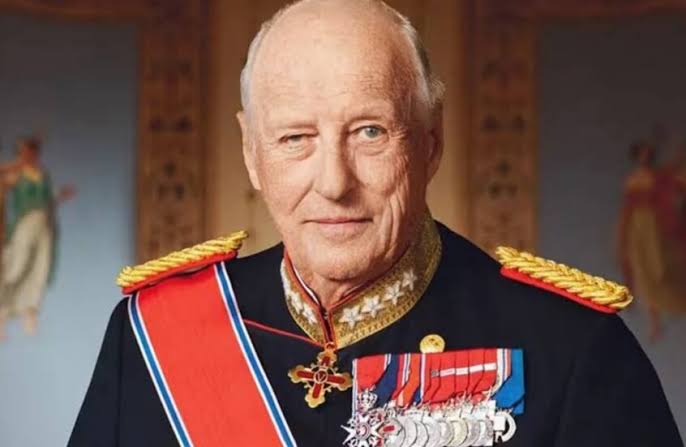
Norway’s King Harald V has died at the age of 89, bringing an end to a 35-year reign during which he became one of the country’s most popular and enduring national figures.
The Norwegian Royal Court said Harald died peacefully at Oslo University Hospital Rikshospitalet on Friday, August 28, at 6:35 a.m. He had been receiving treatment after being hospitalised with a serious infection.
Harald, who became king in 1991 following the death of his father, King Olav V, was 53 when he ascended the throne. He remained Norway’s monarch for more than three decades, serving largely as a ceremonial head of state while becoming an important symbol of national unity.
His death has triggered an outpouring of tributes across Norway, with large crowds gathering outside the Royal Palace in Oslo to lay flowers and pay their respects.
Harald was widely regarded as a modernising monarch who helped make Norway’s royal institution more accessible and closely connected to ordinary citizens.
Unlike the more formal image traditionally associated with European royalty, Harald was known for his warmth, humour and willingness to speak about issues affecting contemporary Norwegian society.
His public support for inclusion and tolerance was particularly notable. In a widely remembered 2016 speech, he spoke about the diversity of Norwegian society and emphasised that people should be free to determine whom they love and how they live. The speech became one of the defining moments of his public role.
The king also maintained a strong connection with Norwegian outdoor life and sports. He was an accomplished sailor and represented Norway in sailing at three Olympic Games before becoming king.
Harald’s reign also covered some of the most difficult moments in modern Norwegian history.
He played a prominent symbolic role following the 2011 terrorist attacks in Oslo and on Utøya, when 77 people were killed. His public appearances and messages of unity helped reinforce the monarchy’s role as a source of national solidarity during periods of tragedy.
Although Norway is a constitutional monarchy in which political power rests with elected institutions, Harald’s popularity gave the monarchy considerable public visibility.
He consistently enjoyed strong approval ratings and was widely viewed as a stabilising figure above party politics. Prime Minister Jonas Gahr Støre described his influence as profoundly positive and praised his dedication to the Norwegian people.
Harald’s death immediately triggered a change at the top of Norway’s constitutional monarchy.
His son, Crown Prince Haakon, has succeeded him and become King Haakon VIII. The new monarch, 53, has already addressed the nation, paying tribute to his father and promising to uphold Norway’s democratic and constitutional traditions.
There will be no traditional coronation. Instead, Norway is expected to follow its established constitutional procedures, including an extraordinary Council of State and an oath before parliament.
Norway has declared a period of national mourning, with Harald expected to be buried in the royal mausoleum at Akershus Fortress following funeral ceremonies in Oslo.
Harald’s death marks the end of an era for Norway. He became king when the country was still emerging from the political and social changes of the late 20th century and remained on the throne through decades of technological, cultural and geopolitical transformation.
For many Norwegians, he was the only king they had known throughout most of their lives.
His legacy is likely to be defined less by political power than by his ability to represent continuity, national identity and unity in a rapidly changing society.
As Norway begins a new chapter under King Haakon VIII, the country is mourning a monarch who spent 35 years serving a nation that largely came to regard him not simply as its king, but as a familiar and trusted national figure.